Summarize this blog post with:
Quick Summary
AI chatbots and AI agents help businesses improve efficiency, automate tasks and enhance customer experiences, but they serve different purposes. AI chatbots handle routine interactions such as answering FAQs, qualifying leads, scheduling appointments and providing product recommendations. They are ideal for businesses looking to improve customer communication and deliver quick responses.
AI agents go beyond conversations by managing complex workflows, making decisions and completing multi-step tasks. They can support sales automation, customer service, financial reporting, HR and supply chain management. Choosing between an AI agent and an AI chatbot depends on your business goals, workflow complexity and automation needs. Businesses can also combine both to achieve better operational efficiency and growth.
Table of Contents
Businesses are majorly adopting AI agents and AI chatbots to automate their operations, handle customer interactions, and encourage service efficiency. As companies are looking for faster and more scalable workflows, investing in AI development solutions has become a strategic priority. According to statistics, 52% of business executives claimed their organizations deploy AI agents in production.
Most chatbots are curated to chat, respond, refer, or offer information. On the other hand, AI agents can do more, like pursue a goal, manipulate a suite of interconnected tools, and make choices within limits. So, choosing between AI agents and chatbots can directly affect your automation capabilities, operational expenses, and customer experience.
Understanding how each technology works helps businesses make informed decisions. This comparison explores their prominent differences, abilities, business applications, and much more.
An AI chatbot is a conversational application designed to interact with users through natural language. It receives a message, assesses the user's intent, retrieves relevant context when needed, and generates a response. Modern AI chatbots have the capability to use business knowledge bases, large language models, retrieval-augmented generation, APIs and databases, conversation memory, structured outputs, business rules, etc.
Businesses commonly use AI chatbots and AI development solutions for answering FAQs, handling basic customer support requests, sharing product data, and offering round-the-clock customer assistance.
Here is a detailed reference that explains the working mechanism of AI chatbots.
An AI agent is an AI-powered system that pursues a goal by handling a workflow, making decisions within defined boundaries, and using tools or external systems to complete tasks. AI agents can analyze your data, plan actions, and execute multiple tasks independently. Through artificial intelligence development services, your business can build AI agents that connect with external tools. Further, they can access databases and automate complicated workflows.
They use reasoning capabilities to assess situations, select appropriate actions, and adjust their approach based on results. This makes them useful for advanced business automation and decision-making.
Here is how AI agents work in the recent scenario and how they win the AI agent vs. chatbot customer service debate.
Also Read: Top 10 AI Agent Development Companies in the USA to Watch in 2027
Although both technologies use artificial intelligence to interact with users, their abilities and business applications differ significantly. AI chatbots mainly focus on answering queries and managing conversations, while AI agents can make decisions, execute tasks, and automate complicated workflows. Understanding such differences can help your business choose the right technology based on your operational needs. Here is a detailed comparison table between AI agents and chatbots.
| Factors | AI Chatbots | AI Agent |
|---|---|---|
| Purpose and Functionality | Curated to answer your queries, offer information, and handle basic conversations. | Designed to achieve specific goals by accessing data, making decisions, and performing tasks. |
| Autonomy and Decision-Making | Generally responds to user inputs based on trained data, instructions, or predefined conversation flows. | It can independently assess situations, decide the next actions while adapting its approach to get a goal. |
| Task Execution Capabilities | It can handle simple tasks like answering FAQs and checking order status. | It performs multi-step tasks like processing requests, updating records, and coordinating multiple operations. |
| Workflow Automation | Automates individual interactions and repetitive customer communication. | It automates complete workflows including multiple steps, systems, and decisions. |
| Integration Requirements | Often connects with knowledge bases, websites, and basic CRM systems. | Might require deeper insights with APIs, databases, enterprise software, and external tools to execute tasks. |
| Human Involvement | It might need human support when queries fall outside its programmed abilities. | Can handle many tasks but still needs human intervention for sensitive decisions and approvals. |
| Development Complexity | Easier to develop, train, test, and deploy. | Requires more complicated architecture. |
| Scalability and Maintenance | Can scale your customer conversations, but expanding its capabilities might need additional training. | Can support broader business operations, although scaling needs monitoring integrations. |
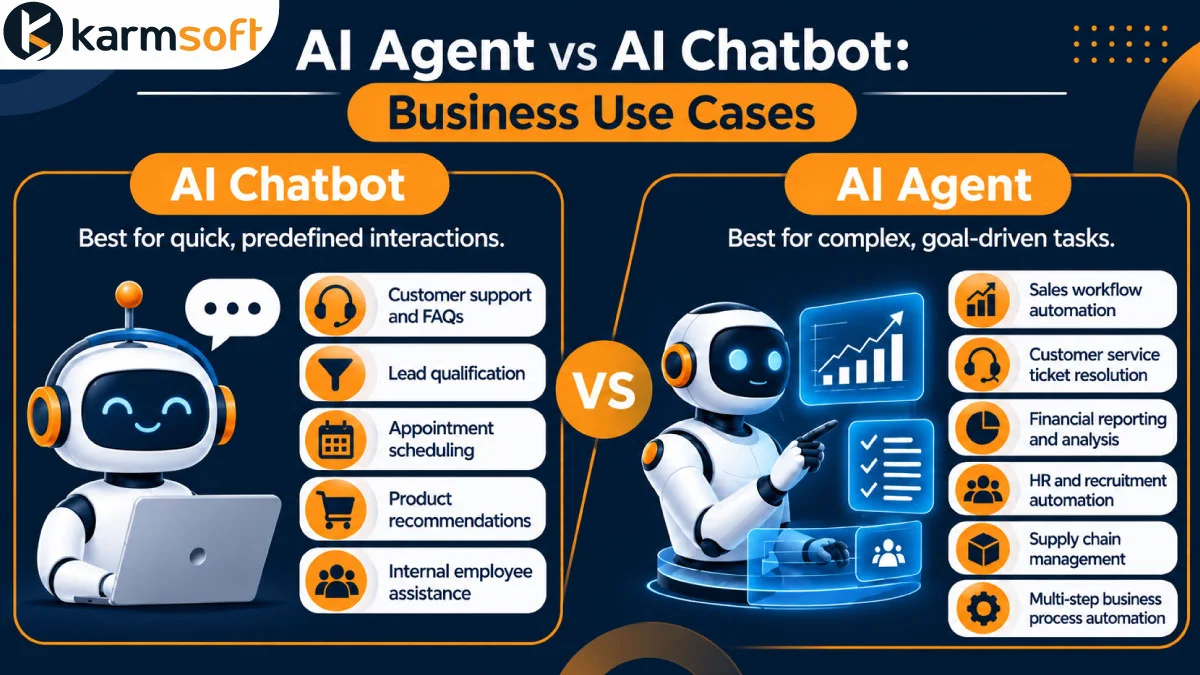
Let's get into the use cases and their relevance when it comes to the AI agent vs. AI chatbot difference.
AI chatbots can help your business manage customer interactions more effectively without increasing the workload on your support teams. They can automate repetitive conversations, offer quick access to information, and make customer assistance more accessible. Their influence can be much better with the help of artificial intelligence development solutions.
AI chatbots respond to customer queries instantly instead of making users wait for an available support representative. This reduces your response times.
Chatbots remain available outside regular business hours, including weekends and holidays. Customers can access product data while resolving their basic queries.
By handling repetitive questions and routine requests, chatbots allow support teams to focus on complicated customer issues. This helps reduce manual work.
Chatbots follow configured guidelines and use approved information when responding to customers. This helps maintain consistent messaging across different conversations.
Businesses can deploy chatbots for specific tasks like answering FAQs, gathering enquiries, or sharing service data without building complicated automation systems.
Interactive conversations, customized responses, and quick access to necessary information make it easier for customers to explore products and services.
Also Read: AI Development Timeline: How Long Does It Take to Build an AI Solution?
AI agents help businesses move beyond basic conversational automation by managing tasks that include multiple steps, decisions, and software systems. With the right implementation, they can reduce operational challenges while improving team efficiency.
AI agents can handle workflows including multiple tasks, systems, and decision points. They can coordinate activities like processing requests and updating records.
Advanced AI development services can automate time-consuming activities like document processing, data entry, information retrieval, and routine follow-ups.
AI agents assess information from connected systems and evaluate possible actions as per defined objectives. This helps teams access relevant insights and makes operational decisions more quickly.
By taking over your routine responsibilities and assisting with complicated tasks, AI agents can reduce administrative workload for employees. Teams can complete processes more effectively.
AI agents can interact with multiple business applications through APIs and integrations. For example, they can retrieve CRM data and update project management tools.
You can configure AI agents for multiple operational needs, from sales coordination to financial analysis.
Here is a brief consideration of what to choose when it comes to AI chatbot vs. AI agent for startups or enterprises.
Picking the right AI technology begins with understanding your business risks and automation goals. Professional artificial intelligence development solutions can help your business build intelligent chatbots and AI agents curated to your operational needs. So, whether you desire better customer interactions or advanced workflow automation, explore scalable AI development and integration services to turn your ideas into practical business solutions.
Key Takeaways

About the Author
Hardik Panchal, CTO, Scrum Master, and Software Architect at Karmsoft, leads the charge in creating innovative web and mobile applications. His technical expertise and commitment to client satisfaction drive Karmsoft’s success. Hardik is passionate about turning ideas into practical digital solutions that help businesses grow.
 AI Development
 ChatGPT
 Google AI
 Perplexity
 Claude
 Grok