Blog AI Development
AI Development Cost in 2026: A Complete Pricing Guide
August 05, 2026Hardik Panchal
BlogAI Development
August 05, 2026Hardik Panchal
Summarize this blog post with:
Quick Summary
AI development costs in 2026 can range from $15,000 for a simple Proof of Concept to $500,000+ for advanced enterprise AI platforms. The total cost depends on project complexity, data quality, AI model selection, integrations, security, infrastructure, and development expertise. Starting with a Proof of Concept, using pre-trained models, focusing on high-value use cases, and developing in phases can help businesses manage AI development costs effectively.
Table of Contents
The cost of creating an AI solution ranges from $20,000 for a simple application to $300,000 and beyond for a tailored enterprise platform. The exact cost will vary largely depending on the features, data needs, and technology.
Every industry is keen on investing in the power of AI, but the problem is funding. The concept of “AI development” is too general. It’s important to recognize that a basic customer service chatbot is not in the same league as an advanced generative AI tool, even if a vendor’s proposal suggests otherwise.
Before any business considers adopting an AI development solution, they must have clarity about the budget. By the end of this guide, you’ll have a better sense of the actual AI development cost for different kinds of projects.
The cost of AI development varies from $15,000 for a simple Proof of Concept up to $500,000+ for an enterprise AI platform, depending on the complexity of the use case, the readiness of the data, and the scale.
The overall cost of ownership depends on cloud infrastructure, data preparation, model monitoring, and compliance. Businesses that only allocate resources to the development phase are always struggling with finances after deployment.
Estimating the cost of AI development requires a clear look at your business goals and technical needs.
A basic system usually involves simple automation, rule-based chatbots, or lightweight data classification. These typically cost between $15,000 and $75,000. These projects require little data, low computing power, short build times, and use pre-trained models.
Mid-level projects introduce custom machine learning models, deeper integrations, and specific data training. The cost of developing these mid-level projects usually falls between $50k and $200k, based on how much data you’re looking to work with.
Enterprise systems are designed to address complex, large-scale business problems with deep learning, large language models (LLMs), or agentic workflows. These sophisticated platforms cost between $200,000 and $500,000 or more because they need particular expertise and months of development.
When your software needs to talk to legacy ERP systems, cloud databases, and third-party APIs, the engineering complexity skyrockets. These highly integrated AI development solutions typically drive project costs up by $25,000 to $100,000.
A text-generating assistant operates very differently from a visual inspection tool on a manufacturing line. So, the pricing is highly dependent on the type of technology that you choose to create.
Your generative AI development cost will typically range from $30,000 to $500,000 or more, depending on the scope and level of customization. Small-scale solutions involve content generation with pre-trained models, and enterprise-level solutions involve custom models and extensive datasets.
These include AI content generation tools, custom AI assistants, RAG systems, integration with large language models, and edge AI development services. The cost of a scoped generative AI proof-of-concept is $8,000-$25,000, a single production workflow is $35,000-$70,000, and a multi-workflow generative AI production system is $70,000-$150,000+, along with continued costs for run-time model inference, hosting, and monitoring.
The cost to develop a basic FAQ bot is generally $10K to $25K. An advanced AI sales agent can keep your context in mind, qualify leads, and sync with your CRM, but it costs between $50K and $80K or more. The cost is tiered according to the number of integrations and the level of NLP needed.
Historical data patterns are the basis for predictive analytics, demand forecasting, and fraud detection systems. These systems need a lot of data cleaning and algorithm training, meaning that they need a solid data science team. The expense of machine learning development ranges from $10,000 to $200,000 or more, based on the size of the data set and the complexity of the system. A medium-sized ecommerce business would spend $120K to $300K on a recommendation engine and $100K to $300K on demand forecasting for their retail or supply chain.
Computer vision AI is a more technical and expensive category of AI, primarily because it requires large, well-labeled image data sets. Basic object detection projects begin at $10,000-$30,000. Real-time video analysis runs $40,000-$100,000. Advanced 3D solutions cost more than $100,000. Depending on the resolution and real-time processing needs, these visual projects cost between $30,000 and $150,000.
Basic AI agents, which are able to process structured workflows, will cost about $30,000 to $80,000. Advanced AI agents can cost $80,000 to $250,000+ with capabilities for multi-step reasoning, deep integration, and continuous learning. Among the most rapidly increasing investment categories in 2026 are sales automation agents, customer support agents, workflow automation agents, and multi-agent AI.
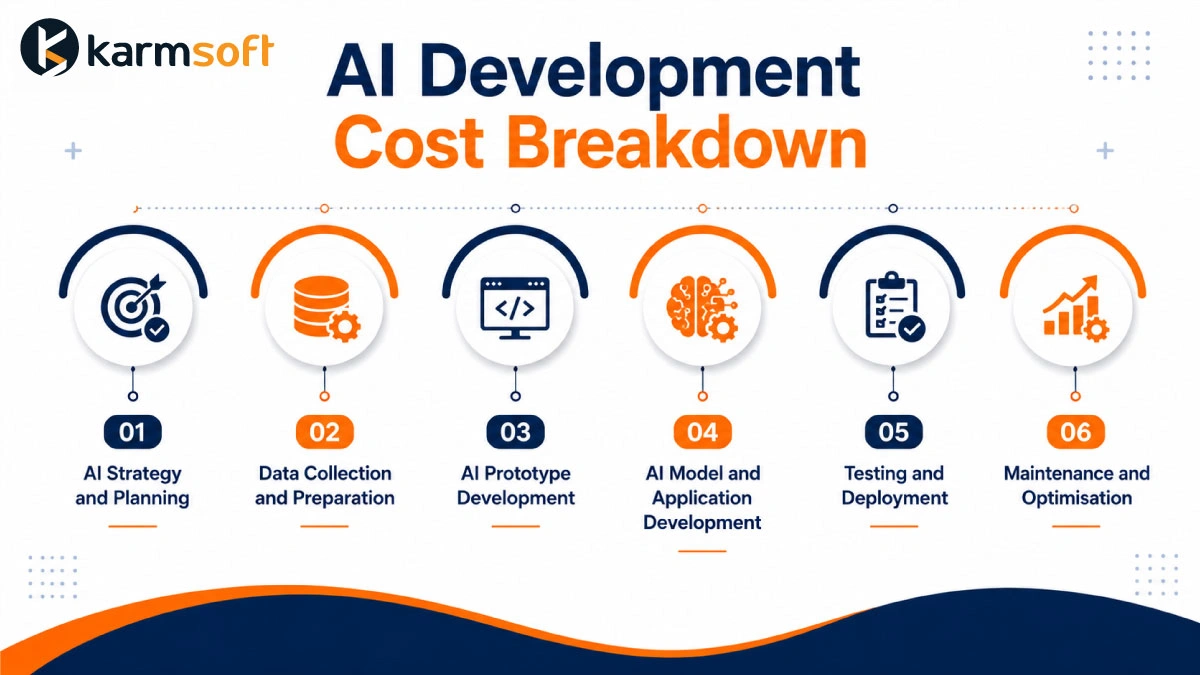
Knowing what you’re paying for at every stage is a great way to budget wisely and not overspend as the majority of organizations do. Your AI development cost breakdown comes down to the same variables; get them right, and your budget will be within 15% of what it should be; get them wrong, and you’ll be at 200-400% of plan by month six.
Every solid AI project starts here. This stage includes business requirement analysis, AI use case selection, technical feasibility assessment, and project roadmap preparation. It usually lasts 2-4 weeks. Be prepared to spend 10-15% of your overall budget ($5,000 to $30,000) on the discovery and planning phase.
The biggest cost drivers are not the AI model itself, but data quality, integration complexity, accuracy requirements, and inference volume. The process to gather, clean, validate, label, and manage data storage takes 4-12 weeks and costs $10,000 to $150,000. The more complex and industry-specific the data, the higher this number goes.
A proof of concept is used to confirm the viability of an idea, check technical feasibility, and test the availability of information before investing in full development. This prototype stage enables essential stakeholder input and is important in guaranteeing that you’re investing in a viable AI development solution. It is usually $10,000 - $40,000 and can save multiples of that in rework downstream.
This is the essence of the building process: algorithm and model selection, model training and fine-tuning, front-end and back-end development. This stage can cost anywhere from $20,000 to more than $500,000 and is typically 25% to 35% of your budget. It also involves developing intuitive dashboards and APIs to allow your team to truly interface with the new software.
The standard cost for model accuracy testing, security and performance testing, third-party integration, and deployment on cloud or on-premises is $15,000 to $80,000. This represents 15-20% of the total project and cannot be negotiated if you require the system to work at scale.
Continuing costs such as model monitoring, retraining, security updates, and technical support do not cease after the launch of the model. Budget 15% to 25% of your original software development expense every year for software maintenance.
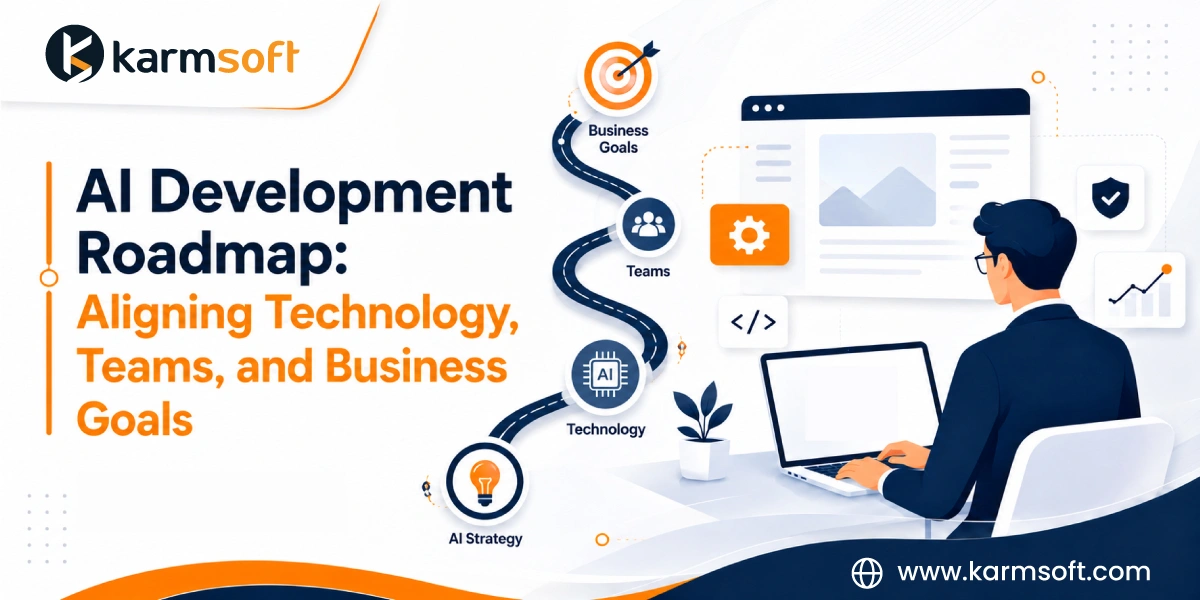
Also read :- AI Development Roadmap Aligning Technology, Teams, and Business Goals
The pricing is different for every project, and it depends on some of the fundamental factors. By comprehending these variables, you can better manage your AI development cost before things go out of hand.
The more features there are, the more time it takes to develop. The higher the level of automation that is required, the more sophisticated the algorithms need to be. It’s much quicker to build a simple tool which categorizes emails than a scalable system which predicts global supply chain disruptions.
The cost of cleaning up data that is fragmented, inaccurate, or resides on old systems is expensive. When you’re forced to buy data from third parties, it can become very expensive. Regulated industries have privacy restrictions that mandate extra handling requirements, which further lengthens the timelines and budgets.
Pre-trained models significantly shorten the time and cost of building as opposed to training from scratch. Open source models are flexible; however, the configuration and maintenance demand more engineering skills. Artificial intelligence development solutions such as OpenAI, Google, or Anthropic come with recurring usage fees that increase based on the volume of usage. Custom machine learning models provide the greatest control, but will cost the most up front.
Linking AI outcomes to your CRM, ERP, cloud platforms, legacy systems, or third-party APIs introduces engineering complexity each and every step of the way. Each integration is unique and involves custom development, testing, and documentation. For complex integration projects, 20% of your project time is easily spent on the integration itself.
Data protection, access management, and regulatory compliance aren’t free. Gartner estimates that worldwide AI governance spending will exceed $492 million in 2026, and will exceed $1 billion in 2030. Development and audit costs from HIPAA, GDPR, SOC 2, and industry-specific frameworks will all make an impact, especially in healthcare, finance, and government.
AI engineers, data scientists, software developers, UI/UX designers, and QA specialists command high salaries. Specialized knowledge always carries a premium. Offshore teams can achieve 30-50% savings on blended cost without impacting quality, and teams with domain expertise can cut down on risk and iterations at the same time.
The financial commitment does not end when your software successfully launches into production. Cloud computing, software licensing, and ongoing model maintenance needs must be considered to make sure the company is profitable in the long run.
High-performance models need a high amount of computing power in GPUs and extensive data storage. Consider implementing edge AI development services for real-time processing needs on local hardware, such as manufacturing cameras or IoT sensors. When scaling models from testing to production environments, cloud compute costs can rise 10× and beyond.
LLM APIs, speech and vision APIs, translation and analytics tools have usage-based pricing that increases with your user base. These providers are usage-based; that is, the more users and transactions you have, the more you pay.
AI models don't stay accurate forever. There are ongoing expenses associated with performance monitoring, model updates, new data preparation, and accuracy enhancements. One of the most prevalent patterns of AI project failure is for organizations to allocate 60-80% of their project time to data preparation and just 20-30% to the project itself.
Similar to other software, your application will need periodic bug fixes, security patches, and feature enhancements. A technical support team is required to deal with user problems. Expect to spend around 20 percent each year in maintenance fees on the original build cost.
Also read :- Top AI Development Companies in Australia Delivering Custom AI Solutions
When building new software, leaders often wonder whether to start from scratch or buy an off-the-shelf platform. It’s important to compare the steep and upfront cost of custom AI development against the ongoing costs of paying for ready-made software.
A custom-made AI is built around the needs of your company. You are in charge of the data, features, and architecture. At first glance, the cost is much greater, but as your company expands, there will be no per-user licensing fees to pay, and you own the IP.
Off-the-shelf AI is faster to deploy and has lower initial costs. The downside is the lack of customization, ongoing subscription fees, and vendor dependency. By selecting the appropriate model, such as in-house or offshore development, the total AI development cost can be reduced by 30 to 50 percent without compromising on quality.
A hybrid solution is a mix of off-the-shelf third-party components and custom-built functionality. This saves development time, balances cost and flexibility, and can achieve 85-95% of custom performance at 10-15% of the cost of building from scratch.
Firstly, clearly specify the business problem. Unspecific requirements result in wrong estimates. Then focus on the vital AI capabilities and postpone everything else for a future stage. Be realistic about data readiness; it is much more expensive to come up with data issues once the process has started rather than before it begins.
Determine integration needs at the beginning, as every system interface will cost time and money. An accurate AI development cost estimation is required to attract financing and get the stakeholders on board with a single objective. Estimate the cloud infrastructure costs, and budget at least 20% of your estimate for unknown technical challenges.
With a bit of strategic planning, phased rollouts, and smart technology decisions, you can significantly reduce your financial risk.
Prove the concept before fully developing. Check if the data is available, if there are any technical risks, and if it is possible to achieve the expected outcome using the data available. It takes a few weeks to complete PoC work, but it can save months of costly rework.
Don’t include excessive functionality at launch. Focus on one particular workflow with a clear and measurable outcome, like automating invoice processing or predicting customer churn. This helps to limit initial spend and shows the ROI.
The use of pre-trained foundation models can save hours, days, or even weeks in training time, infrastructure expenses, and development speed. You can save 60-80% on the initial development costs, depending on the application.
Phased delivery ensures investments are in line with results. Iterate and gradually add new features based on feedback from the real world. This avoids high sunk costs on features that do not provide value.
Check their technical experience, examine appropriate case studies, and make sure they are transparent in their pricing model. Also check if post-launch support is available before signing anything.
The right partner makes it easy to manage the cost of custom AI development while also providing a reliable, high-performing product.
Don’t take their word for it; look at a list of their relevant projects. A company that has created 10 recommendation engines is not necessarily familiar with the field of fraud detection or computer vision.
Your users and the business are safeguarded by data privacy standards, security measures, and responsible use of AI. Inquire about how the company treats data throughout the development process. Find out if your data is used to train outside models, and if the team has compliance certifications.
Inquire about planning approach, development methodology, testing procedures, and communication process. A reliable partner will provide prototypes early, manage scope changes transparently, and maintain clear communication throughout the project. Just make sure their AI development cost estimation includes long-term maintenance services and post-launch support.
Research for pricing transparency, flexible engagement models, and clear maintenance services. Deloitte reports that the average ROI of a $1 spend on generative AI is $3.70, yet 94% of organizations are not capturing the significant enterprise value. The right development partner is the one to get you in that 6%.
The key considerations for costs include complexity, data quality, the type of model, integration level, security, and team proficiency. An AI discovery session is the best place to start because they clearly articulate the business problem, evaluate the availability of data, and plot out realistic costs and development before you get started.
Based on that, you can assess whether the AI development solutions you are considering are indeed suitable for your needs or not. Contact a team of experts today to get a personalized quote for your artificial intelligence development solutions, and learn how to get the most value for your generative AI development cost.
Key Takeaways

About the Author
Hardik Panchal, CTO, Scrum Master, and Software Architect at Karmsoft, leads the charge in creating innovative web and mobile applications. His technical expertise and commitment to client satisfaction drive Karmsoft’s success. Hardik is passionate about turning ideas into practical digital solutions that help businesses grow.
 ChatGPT
 Google AI
 Perplexity
 Claude
 Grok
Grok