Blog AI Development
AI Development Roadmap Aligning Technology, Teams, and Business Goals
July 06, 2026Hardik Panchal
BlogAI Development
July 06, 2026Hardik Panchal
Summarize this blog post with:
The AI roadmap for business serves as the organized blueprint that guides a company from its vision to integration. An organized roadmap is necessary for avoiding costly mistakes and ensuring every AI initiative drives real business value. Nowadays, various companies are experimenting with AI, but only a few of them have the potential to transform with it. A clear and strategic roadmap for business ensures that it aligns with your technology initiatives and crucial business goals.
The enterprise edge AI development services roadmap is the comprehensive long-term strategic plan that outlines how a firm leverages AI to achieve its objectives. An AI development solution connects your high-level vision to a practical AI implementation plan. This article defines the necessary agentic AI development roadmap, potential risks, and the KPIs for success.
For firms, AI refers to moving from simple automation to strategic transformation. By deploying technologies like Gen AI, ML, and NLP, businesses can drastically streamline operations, boost productivity, and improve user experience. It helps businesses to uncover actionable insights from vast data metrics.
AI helps to manage repetitive tasks, allowing employees to focus on the high-value, strategic work. AI agents are increasingly used to coordinate actions across various enterprise systems. AI development solutions help businesses make valuable decisions while enhancing customer experience.
AI development solution assists companies in streamlining workflows, automating repetitive tasks, and lowering manual labor across departments. In the long run, this increases overall productivity and profitability while improving operational efficiency, reducing labor and operational expenses, minimizing human error, and enabling organizations to deploy resources more effectively.
AI enables firms to find new income opportunities through predictive analytics, personalized customer experiences, intelligent product recommendations, and data-driven sales methods. It also enhances lead generation, client retention, and pricing optimization, helping organizations increase sales performance and achieve sustainable business growth.
By providing intelligent chatbots, quicker response times, personalized interactions, and proactive help, AI raises customer happiness. Companies may create seamless experiences that increase customer engagement, loyalty, and long-term connections by better understanding customer behavior, forecasting preferences, and making customized recommendations.
Adopting artificial intelligence development solutions gives businesses a competitive advantage by speeding up decision-making, increasing operational effectiveness, spurring innovation, and reacting swiftly to changes in the market. AI-driven insights assist companies in identifying new opportunities, optimizing strategy, and outperforming rivals in the delivery of superior goods and services.
A future AI development roadmap provides a systematic framework that helps firms integrate artificial intelligence with clear objectives and measurable achievements. By offering a clear implementation approach, a well-designed AI agent development roadmap helps companies make wise investment decisions. Instead of chasing various projects, it allows organizations to prioritize high-impact AI use cases that deliver profitable value.
Businesses may increase productivity, save operating costs, improve customer experiences, and boost revenue growth by coordinating AI initiatives with business objectives. Additionally, an agentic AI development process creates key performance indicators, which facilitate monitoring advancement and success over time. It also reduces implementation risks and enhances business-technical team collaboration. It guarantees that AI initiatives stay targeted, scalable, and able to produce long-term, sustainable business results.
Organizations frequently begin projects with unclear commercial objectives or success criteria in the absence of a clear AI roadmap. As a result, priorities shift, resources are allocated inefficiently, implementation is delayed, and AI solutions are unable to address actual business issues or deliver profitable returns on investment.
Conflicting expectations and communication gaps occur when technical teams and business executives operate separately. This lowers the overall efficacy of AI initiatives by causing miscommunications and delayed decision-making. It is also caused by poor AI development solutions and implementations that are not in line with user requirements or corporate objectives.
AI systems rely on current technology infrastructure and trustworthy data. Poor-quality, inadequate, inconsistent, or siloed data, paired with outdated technologies, affects model accuracy, delays deployment, and raises implementation costs. It prevents organizations from establishing scalable and high-performing AI solutions.
Many companies successfully finish AI pilot programs, but they find it difficult to implement them throughout the entire company. Weak governance, inadequate infrastructure, integration issues, inadequate finance, and a lack of long-term planning are common barriers that keep AI programs from producing long-term enterprise-wide benefits.
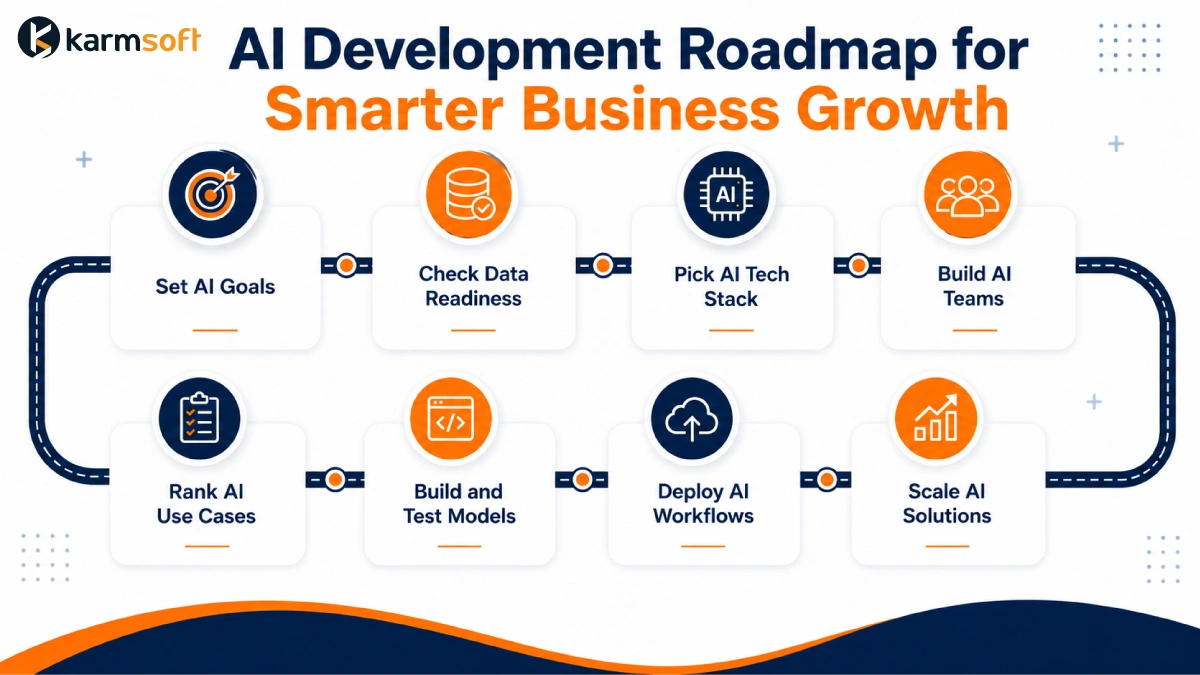
Establishing specific business objectives is the initial stage in any AI development process. Organizations should define the precise difficulties they want AI to tackle, such as improving customer service, automating repetitive processes, increasing operational efficiency, or strengthening decision-making. To guarantee profitability, AI projects should fulfill the business vision.
Next, map appropriate AI use cases that directly contribute to these objectives, concentrating on areas where AI can have the biggest influence. To measure success, set up KPIs like revenue growth, cost reductions, increased productivity, or customer happiness. Well-defined goals offer guidance, lower project risks, and assist teams in setting priorities for the appropriate AI projects.
For AI systems to generate trustworthy outcomes, data must be precise, pertinent, and well-structured. In the second AI development process step, start by assessing your current business data's accessibility, consistency, and quality. Identify any missing, outdated, redundant, or siloed information that could influence AI model performance. To guarantee seamless access for AI applications, examine how data is gathered, stored, and distributed among departments.
Create robust data governance guidelines that address ownership, security, privacy, and adherence to industry rules. AI readiness can be further strengthened by standardizing data formats and enhancing documentation. Early resolution of data concerns decreases long-term maintenance costs, enhances model correctness, and minimizes implementation problems. Businesses can create scalable, reliable, and high-performing AI solutions with a solid data foundation.
Selecting the right AI technology stack is critical for generating scalable and efficient AI solutions. Based on their technological needs and plans for future expansion, businesses should assess AI platforms, machine learning frameworks, cloud services, databases, and integration tools. Determine whether buying an existing platform or creating a custom AI solution better suits your company's objectives, financial constraints, and schedule.
You must consider a few elements such as scalability, integration support, customization, and support. By making sure the selected technology supports encryption, access restrictions, and regulatory compliance, security should also be given first consideration. A well-chosen AI tech stack facilitates long-term innovation throughout the company, streamlines development, boosts performance, and lowers operational complexity.
Business executives, technical specialists, and operational teams must work together for AI implementation to be successful. Create a cross-functional AI team of domain experts, project managers, software developers, data scientists, AI engineers, and business analysts. To increase responsibility and project efficiency, each member should have well-defined roles and duties.
To guarantee that AI solutions meet actual business needs, promote frequent contact between technical and business stakeholders. Organizations may deploy AI more successfully while lowering failure by prioritizing upskilling. Better decision-making, quicker problem-solving, and more seamless execution are all made possible by strong teamwork. Successful AI development and long-term business growth are made possible by a competent and well-coordinated AI workforce.
Not every AI innovation produces the same business value, making prioritization a vital step. Consider commercial effect, technical viability, implementation cost, available data, and anticipated return on investment when evaluating possible AI use cases. Initially, concentrate on quick-win projects that are simpler to execute and show profitable value in a shorter amount of time.
Early wins boost stakeholder support, boost confidence, and generate impetus for more ambitious AI projects. Steer clear of choosing extremely complicated projects with little business value or inadequate information. Create a methodical approach for prioritization that strikes a balance between risk, value, and implementation effort. Ranking AI use cases strategically helps organizations deploy resources efficiently while maximizing the overall benefit of AI investments.
Also read :- Top AI Development Companies in Australia Delivering Custom AI Solutions
Building and evaluating AI models come after use cases are chosen. To begin, prepare high-quality datasets for model training by labeling, cleaning, and converting the data. Based on the business challenge, choose appropriate machine learning methods and train models using pertinent datasets.
To guarantee reliable outcomes, thoroughly test models after development for accuracy, dependability, fairness, and potential bias. Verify results with subject matter experts and business stakeholders to make sure they meet operational requirements. Before deployment, performance testing in various circumstances helps in identifying vulnerabilities. Reliable insights and confidence in corporate decision-making are supported by proven AI algorithms.
A smooth interface with current corporate systems and procedures is necessary for the effective deployment of AI. Connect AI models with applications such as CRM, ERP, customer service platforms, or internal workflows to allow real-time automation and decision assistance.
Make sure that the deployment incorporates the proper monitoring tools, security measures, and system dependability. Human monitoring should remain in place for important decisions to maintain accountability and compliance. An organized deployment strategy boosts user engagement, reduces disruption, and enables businesses to fully reap the rewards of implementing AI.
Businesses should concentrate on extending AI capabilities across departments and processes following a successful implementation. Keep an eye on AI performance using predetermined KPIs to make sure models are still producing useful and accurate outputs. Keep an eye out for data drift, shifting company circumstances, or changing consumer behavior that could eventually diminish the efficacy of the model.
To keep AI models accurate and current, retrain and update them frequently using new, high-quality data. As the use of AI increases, uphold strict governance, security, and compliance procedures. Organizations may boost productivity, foster creativity, improve efficiency, and achieve long-term, sustainable company growth by strategically scaling AI.
Establish thorough governance policies. While encouraging moral AI practices, responsible decision-making, user privacy, cybersecurity, and risk management throughout the AI lifecycle, make sure that industry regulations are followed. Edge AI development services enable AI models to analyze data closer to devices, boosting response times, lowering latency, and strengthening data privacy.
To identify bias, enhance fairness, and guarantee consistent performance, AI models should be continuously assessed. Organizations can meet compliance standards, foster responsible decision-making, establish accountability for AI-generated results, and foster confidence through regular audits, explainable AI methodologies, and transparent reporting.
Establish clear ownership assignments for AI development framework, deployment, monitoring, and risk management through organized approval procedures. Defined roles and duties increase governance, strengthen accountability, accelerate decision-making, and ensure every AI project respects organizational rules, security standards, and compliance needs.
Also read :- The Ultimate Guide to AI Development Best Practices for Businesses
Before determining the business issues they wish to address, many companies choose AI technology. Establish profitable goals, anticipated results, and success metrics first. Selecting AI solutions after setting specific objectives guarantees improved alignment with business requirements, cuts down on wasteful investment, and increases the chance of successful deployment.
One of the main causes of AI failure in a project is data inaccuracy. Model accuracy and dependability are increased by clean, consistent, and well-governed data. Before creating AI models, establish data governance principles, standardize data sources, and take care of privacy, security, and compliance needs to prevent later, expensive implementation issues.
Without adequate testing, expanding AI systems may result in operational hazards and erroneous forecasts. Use real-world scenarios to verify models' performance, accuracy, fairness, bias, and dependability. To ensure long-term success, get input from stakeholders, make necessary model adjustments, and regularly track outcomes before using AI across business operations.
Building an enterprise AI development roadmap is the necessary step that offers the clarity, focus, and structure required to navigate the complexities of AI adoption. When you collaborate with an artificial intelligence development solutions provider, they follow a methodical process that aligns with your goals and scales your business.

About the Author
Hardik Panchal, CTO, Scrum Master, and Software Architect at Karmsoft, leads the charge in creating innovative web and mobile applications. His technical expertise and commitment to client satisfaction drive Karmsoft’s success. Hardik is passionate about turning ideas into practical digital solutions that help businesses grow.
 ChatGPT
 Google AI
 Perplexity
 Claude
 Grok
Grok