Blog AI Development
AI Development Timeline: How Long Does It Take to Build an AI Solution?
September 04, 2026Hardik Panchal
BlogAI Development
September 04, 2026Hardik Panchal
Summarize this blog post with:
Quick Summary
AI development timeline depends on the type, complexity, and requirements of your AI solution. Learn about the typical time needed for planning, data preparation, model development, integration, testing, and deployment, along with timelines for chatbots, generative AI, machine learning, AI agents, and enterprise AI solutions.
Table of Contents
The adoption of AI has become a necessity for contemporary businesses, yet predicting a realistic timeframe for launching them is difficult. A simple AI development solution can take several weeks, and complex AI development solutions can take several months.
AI development timelines vary by project complexity, data availability, and technical requirements. Data preparation can account for 60–80% of the time in a typical machine-learning project, making data quality a major factor in development speed. This guide covers the key stages of the AI development timeline, common delays, and practical ways to accelerate the process.
Knowing what is involved in the project helps establish realistic expectations for timelines, budget, and goals for the business.
An AI prototype or proof of concept takes 2–6 weeks, and an AI chatbot or virtual assistant takes 4–10 weeks. Typical predictive analytics solutions take 6-12 weeks and custom machine learning applications take 2-5 months. The process of creating a timeline of AI development can be lengthy and depend on the complexity of the project and the technical requirements.
The time for implementing generative AI applications is approximately 2-6 months and for complex enterprise AI solutions 6-12+ months, depending on scope and integrations.
The duration of AI projects can differ as each business has unique needs, features, data, and technical environments. You can achieve user actions and business goals to avoid delays; you can also develop more features, but this can complicate the process.
Gathering, organising and cleaning the data can also be time consuming, particularly with large or erratic data sets. The timeline also depends on the type of model, whether that's an existing API or a custom machine learning model.
Depending on the application, there might be the need to develop a connection to existing platforms and legacy databases. Other project timelines may be extended due to compliance, security, legal and industry requirements.
Also read :- List of AI Integration Services Companies Should Consider in 2026
All AI software development timelines go through a few strategy, development, testing, and deployment stages.
Estimated Timeline: 1–3 Weeks
The team lays out the business problem, identifies use cases of AI, functional requirements, goals and KPIs, evaluates technical feasibility, and develops an initial development roadmap.
Estimated Timeline: 2–6 Weeks
This stage is where you define your data sources, gather structured and unstructured data, clean and organize your data sets, scrub out bad or duplicate data and label training data if necessary, and inspect the data for readiness.
Estimated Timeline: 3–8 Weeks
The team chooses the appropriate models, custom or pre-trained architecture, model parameters, trains the model, creates specific AI development solutions, fine-tunes the model, and performs baseline validation tests.
Estimated Timeline: 3–8 Weeks
Front-end and backend development, API creation, integration of AI models, automated workflows and business logic, and creating user-friendly interfaces and management dashboards.
Estimated Timeline: 2–6 Weeks
This phase includes CRM, ERP, multi-cloud, hybrid infrastructure, legacy databases, SQL/NoSQL databases, third-party APIs, and in-house business process integrations.
Estimated Timeline: 2–5 Weeks
Testing includes functionality, model accuracy, evaluation, stress and latency performance, security, vulnerabilities, encryption, algorithmic bias, fairness and final user acceptance testing (UAT).
Estimated Timeline: 1–3 Weeks
The team installs production infrastructure, installs AI models and applications, configures monitoring and error logging, conducts smoke testing, trains users and operations personnel, and tests the solution.
This continuous process includes checking the accuracy of the model, the drift, its performance and its response times. Over time, teams have the opportunity to retrain models, update datasets and knowledge bases, tweak prompts and workflows, and add new AI capabilities.
The exact timeline of the development of ai depends on the features, software architecture, data needs, integrations, and extensibility of the software.
The time it takes for a basic FAQ chatbot to be built is between 4-6 weeks, and 6-10 weeks for a generative AI chatbot with Large Language Models (LLMs). The time required for enterprise-level conversational AI, which supports multiple languages, is 8–12 weeks. Adding customer support and CRM integration can increase the time to 2–4 weeks for real-time ticket synchronization.
Typically, it takes 1-2 weeks to compare commercial APIs and open-source models for LLM selection. Development of Prompt Engineering can take 2-3 weeks, and the development of Retrieval-Augmented Generation (RAG) can take 3-6 weeks. Knowledge-base integration can be done in 2-4 weeks, followed by 2-3 weeks for guardrails and testing.
This will take 2–5 weeks for the dataset preparation and 2–4 weeks for feature engineering. Typically, the model training takes 3-6 weeks and validation may take 2-3 weeks. Another 2-4 weeks may be needed to package models into production APIs for deployment.
The AI agent development timeline will vary significantly based on the execution logic and tools available. The definition of use-cases can take 1-2 weeks; tool/API integration can take 3-5 weeks. Memory and context management: 2-4 weeks, multiple step workflows: 3-5 weeks. It can take up to 2–4 weeks for agents to be tested and monitored.
They need a good deal of planning and coordination to build any large scale artificial intelligence development solutions. Multiple system integrations can last from 6-12 weeks and complicated business workflows can take 4-8 weeks. Governance may take anywhere from 4 to 6 weeks, security and compliance 4 to 8 weeks and scalability testing 3 to 5 weeks. Another 4-8 weeks may be needed for team training and organization-wide deployment.
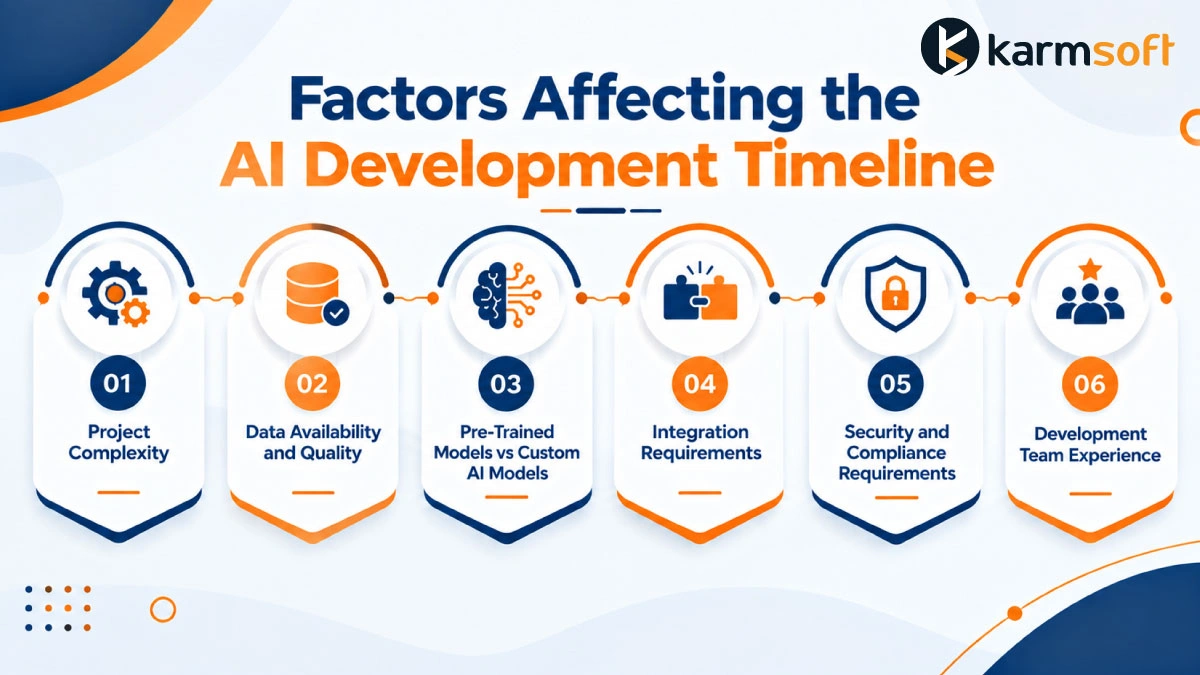
Knowing the key factors that influence the custom AI development timeline is essential for businesses to plan resources and prevent delays.
The complexity of a project is related to the amount of AI functionality, workflows, users and business rules. The development of combined vision, voice and text processing takes longer and autonomous multi-step workflows will need extra validation. Scale testing is also needed for high volumes of users.
Preparation time of existing centralized datasets can be reduced by up to 50%. But fragmented or unformulated data is harder to clean; and manual data labelling takes a few weeks. Other privacy and security requirements apply to sensitive or PII data.
This deployment can be done in a few weeks with APIs and existing LLMs. Finer tuning of the models can take an additional 3–6 weeks, and training and testing of custom models can take 3–6+ months.
Data mapping is key to a CRM and ERP integration, and legacy systems with dirty endpoints can cause significant delays. SaaS applications that have modern webhooks are typically easier to connect to, and common third-party API connectors can reduce integration time.
Expanding development timelines can be caused by data encryption, user access controls, industry regulations, and AI governance. More testing and security measures may be required for healthcare systems that must comply with HIPAA, and for financial applications that must be PCI-DSS compliant.
For seasoned AI engineers and data scientists, creating and designing models can be streamlined. Edge AI development services can reduce specialized hardware deployment and qualified software developers, DevOps engineers and QA experts can create robust pipelines and uncover edge cases earlier.
Also read :- 15 Trusted AI Development Companies in the Dubai for Scalable AI Solutions
Keep it simple and start with a single clear use case, and create an MVP in 6–10 weeks to get initial feedback. Leverage pre-trained models, re-usable APIs and frameworks, as appropriate.
Have clean data and identify integration needs prior to development. Automate testing and deployment with CI/CD pipelines to reduce delays.
Collaborate with an AI expert team following proven development practices, minimizing rework and accelerating delivery.
Even well-planned projects can sometimes be subjected to delays. Requirements that are not clear may result in changing requirements over time, and wasted sprint cycles, lack of quality or sufficient data may stop model training. Another reason for scope changes is they can cause disruption in the release schedule.
If you have complex legacy-system integrations, they could become bogged down due to uncovered endpoints. Model accuracy problems that come up unexpectedly may lead to re-training and security audits at the end may result in later deployment. The lack of knowledge of AI and the limited testing can add to the development time and lead to bugs after the app is launched.
Select an AI development partner who has experience and has an understanding of the industry. Proficiency in data engineering, generative AI/machine learning, and cloud systems and secure API integrations are also beneficial.
The right team must be aware of the security/compliance concerns and be using a well-defined development process, including sprint demos and tracking milestones, with clear communication. After the launch, support in terms of maintenance, monitoring and model updates can minimize long-term risks.
To successfully manage the development timeline of an AI system, it is important to have clear goals, requirements and a roadmap that will guide the development process. Select the best method, whether it's pre-trained APIs or tailored ML models, and collaborate with seasoned developers to ensure dependable edge AI development services.
With the phasing-in of your rollout, the clean artificial intelligence development solutions, you can get your business up and running efficiently while keeping your data quality and stability intact.
Key Takeaways

About the Author
Hardik Panchal, CTO, Scrum Master, and Software Architect at Karmsoft, leads the charge in creating innovative web and mobile applications. His technical expertise and commitment to client satisfaction drive Karmsoft’s success. Hardik is passionate about turning ideas into practical digital solutions that help businesses grow.
 ChatGPT
 Google AI
 Perplexity
 Claude
 Grok
Grok