Blog AI Development
List of AI Integration Services Companies Should Consider in 2026
August 24, 2026Rushirajsinh Jhala
BlogAI Development
August 24, 2026Rushirajsinh Jhala
Summarize this blog post with:
Quick Summary
AI integration services help businesses connect artificial intelligence with existing CRM, ERP, cloud, ecommerce, analytics, and customer service systems. In 2026, companies can use AI integration to automate workflows, improve decision-making, personalize customer experiences, reduce repetitive work, and scale operations without building AI models from scratch.
Table of Contents
Companies of all types are discovering that simply having a smart tool is not enough to ensure they are used to their full potential. For true growth, what’s needed is a tailor-made AI development solution that integrates seamlessly with your day-to-day processes.
Who is this guide for? It’s for business owners, enterprise leaders, and decision-makers looking to expand their businesses.
So what does this mean? Adopting AI is not just a futuristic thought any longer. Chances are, your competitors are already taking advantage of the benefits of AI integration services to streamline their operations, reduce costs, and provide better service to customers.
In this comprehensive overview, we’ll explore the best AI services to consider in 2026. At the end of it, you will have a great idea of what services align well with your business objectives and how to select the right partner that will help you make it happen.
Simply put, AI integration services are the ones that link AI resources to the systems a business already operates. AI is not a replacement for CRM, ERP, or a website but is built on top of these systems to read data, make predictions, and automate tasks in real time.
This contrasts with AI software development, where the emphasis is on creating a bespoke model or application. With integration, you’re taking existing AI capabilities, typically from well-known AI providers, and integrating them into your existing infrastructure. It is quicker, less expensive, and for most organizations more often the wiser choice.
There are some technologies that tend to appear time and again in this area:
You may be thinking about building your own AI or using available ones.
AI development is the process of creating a new, personalized machine learning model from scratch. It requires a lot of effort and large budgets and takes years to accomplish.
AI integration is significantly quicker. It means building on top of high-performing, pre-built AI models and integrating them into your workflows. For the majority of businesses, it makes sense to seek reliable AI integration solutions. It offers you quicker outcomes and eliminates the huge risks of starting from scratch.
From improved customer support to faster data entry, modern enterprise AI integration services can enable you to achieve the desired results in weeks, not years.
This is also why companies are opting for integration over building. By utilizing an existing AI integration service provider, you are taking advantage of organizations such as Google, OpenAI, or Anthropic that have already carried out the research, developed the infrastructure, and are in the process of retraining.
As per Gartner, the global spending on AI is estimated to amount to 2.59 trillion dollars in 2026, a growth of 47 percent from the previous year. That kind of investment tells you where business priorities are headed.
Let’s examine the benefits that businesses can expect when they implement AI correctly:
Retail and manufacturing firms are also beginning to seek Edge AI development services, which process data locally on devices instead of relying entirely on the cloud.
In spite of all this momentum, McKinsey’s State of AI research reveals that the usage of generative AI has increased more than double from 2024, with 88 percent of organizations utilizing it regularly. Yet, just twenty-three percent have successfully expanded artificial intelligence bots throughout an entire corporation. This is the reason why it is crucial to select an appropriate integration partner.
Generative AI integration refers to the application of LLMs and other generative models in business via extensions and interfaces.
A business can integrate an AI assistant into its CRM, knowledge base, document repository, or customer-service platform. That means employees can use AI without switching between different applications.
The best generative AI integration solutions link the model to trusted business data and specify what the AI can access, see, and accomplish.
A customer-support assistant, for instance, has the ability to pull up the latest product handbooks, acknowledged policies, and up-to-the-minute inventory information before creating an answer.
Typical applications include:
By integrating AI chatbots, websites, applications, and customer portals become conversational. With the help of modern conversational AI and machine learning, it is possible to create AI that grasps the context and intent of the query instead of just recognizing a specific word.
A chatbot can:
For instance, a chatbot that is designed to respond to just FAQs is not that useful. By linking the order information of a customer to the chatbot, you can offer a much more helpful experience.
Contact-center staff can benefit from conversational AI too. It can bring up relevant information during a conversation with a person.
This service uses AI to automate repetitive tasks across the business and synchronize them with CRM, ERP, HR, and other business systems. AI can automate processes like data entry, report generation, and approval routing without involving human intervention.
IT professionals save between 10 percent and 50 percent of their time working on manual tasks and focus on performing higher-value tasks. That preserves a significant amount of time within typical professional schedules.
The approval bottleneck can be a great example where this pays off. Instead of sending a specific task to a specific person, AI can take care of the task assignment process according to criteria like type, priority, and content, and escalate when a human decision is required.
Benefits:
With AI integrated into your CRM, you can automate lead scoring, gain customer insights, predict sales, and analyze CRM data on a large scale. Sales teams are able to see which prospects are worth pursuing without having to look through spreadsheets.
These kinds of AI integration solutions also allow sales reps to craft more personalized outreach messages, automatically summarize meeting notes, and produce proposals more quickly.
Benefits:
ERP-integrated solutions help businesses forecast inventory, predict demand, automate processes, and gain insights into their performance.
For example, an AI-backed ERP can alert procurement teams weeks in advance when stock levels of a critical component are on the brink, preventing last-minute rushes and ensuring a smoother procurement process.
Benefits:
This service integrates AI with business intelligence platforms, providing automated data analysis, predictive insights, and real-time business intelligence. Decision-makers receive data-driven reports and recommendations as they flow, rather than waiting for a monthly report.
This is important because too often managers are tied up in the manual process of reporting, which distracts from decisions that should be made based on that reporting. While AI takes care of compiling and highlighting relevant metrics, leaders can focus on acting upon insights rather than searching for them.
Benefits:
Recommendation engines are used to make suggestions to customers about products or content that they may be interested in based on their actions. They are responsible for many of the “customers also bought” sections you see when shopping online.
In addition to product recommendations, they can provide personalized content recommendations and create cross-selling and upselling opportunities, thereby increasing average order value.
In collaborative filtering, products are recommended based on similar shoppers. In content-based filtering, recommendations are based on features of products a customer has previously liked, such as colour, size, or category. Powerful recommendation engines often combine both types for greater accuracy.
Benefits:
AI-powered website search utilizes semantic search and natural-language search to help users uncover what they want, regardless of whether they type the exact keywords.
In large organizations, this can include enterprise knowledge search, where employees gain quicker access to relevant information buried within internal documents.
AI search integration can add:
Benefits:
You require the cloud to operate AI smoothly. By integrating artificial intelligence alongside virtual networks, businesses can maintain the speed, security, and scalability of their cloud infrastructure.
Cloud integration also enables organizations to add resources as needed during peak periods.
AI integration with cloud platforms can support:
Benefits:
Internet shopping is a seriously competitive business. AI can help businesses rise above the competition and offer a more personalized experience for every visitor.
Localized Edge AI development services in physical retail spaces can provide smart checkouts and dynamic pricing while preserving customer privacy.
Meanwhile, predictive analytics can assist retailers in forecasting what items are likely to sell and what products require a promotional push.
Benefits:
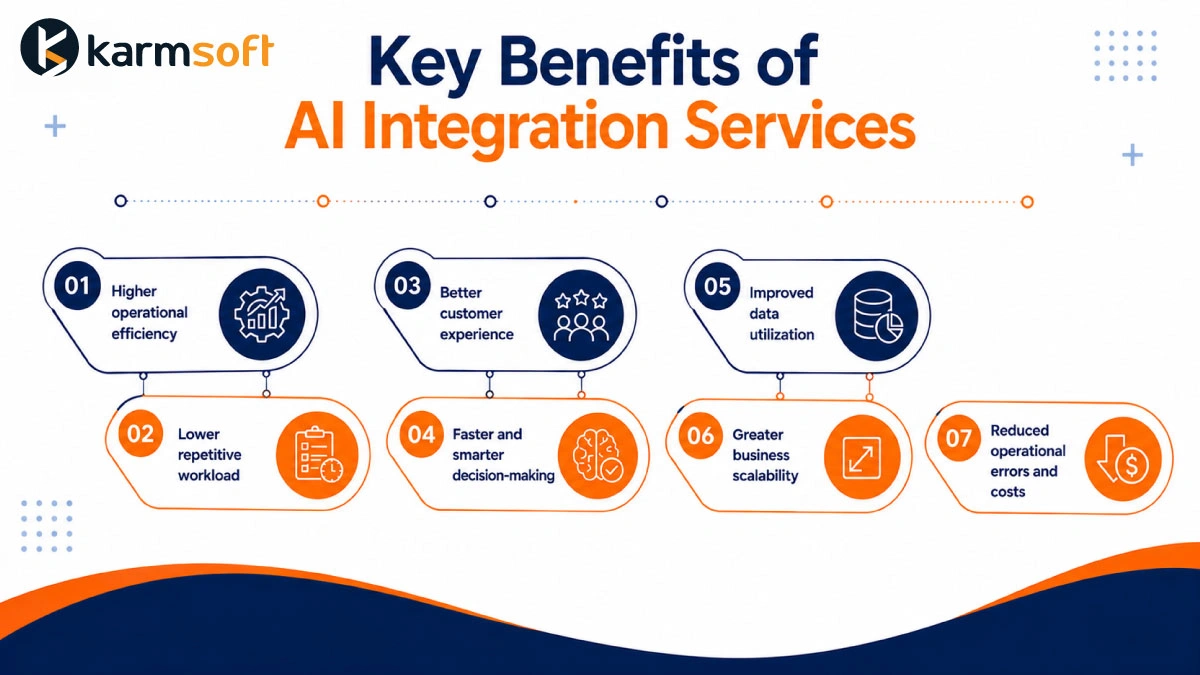
What makes AI such an important adoption trend for business leaders? The answer is the potential business value it can generate. According to Deloitte (2026), 66% of the companies surveyed reported measurable gains in output thanks to AI implementation.
Let’s check out the major advantages that you can enjoy with the introduction of AI development solutions:
To achieve these outcomes, working with a reliable AI integration service provider is one of the best ways to start.
Integration is the right approach for many businesses. It enables organizations to use advanced models such as Gemini, GPT, or Claude without developing foundational AI technology from scratch.
Creating an AI model from scratch is uncommon but can sometimes be essential. If you’re considering full artificial intelligence development solutions, it may be relevant for the following reasons:
But some vendors don’t match particular enterprises. Below are several details worth weighing before signing an agreement.
First, determine which issue requires resolution. Different approaches are needed for faster customer support, better forecasting, and reduced manual work.
Look for a history of successful AI integrations with systems similar to yours, such as CRM, ERP, cloud, or e-commerce solutions.
Inquire about the models and platforms the provider works with. A good AI integration service provider should be able to work with multiple LLMs and cloud providers rather than being restricted to one.
Data governance is more important than ever. Ensure the provider has clear policies for the collection, storage, access, and sharing of data, particularly if you operate in a regulated sector.
Find an appropriate partner that can expand with you. A solution that is effective for a 20-person team should also have a clear path to supporting 200 or more users.
Deploying artificial intelligence is an ongoing process. Inquire about the provider’s post-launch monitoring, updating, troubleshooting, and optimization services.
Don’t just consider the initial price tag. Consider maintenance, retraining, API consumption, infrastructure, and support costs over time rather than focusing only on setup costs.
AI is an ever-evolving landscape. Businesses need to remain future-oriented to keep pace with technological change. Let’s examine the top trends shaping enterprise AI integration services in 2026.
AI is moving beyond basic chatbots towards autonomous AI agents that can strategically plan, take action, and execute tasks through multi-step processes with limited human intervention.
For example, an AI agent may read a document, process its contents, update a system, and prepare an email without requiring separate instructions for every step.
AI is not just about text anymore. Multimodal AI tools can process text, visuals, audio, and video content together. This helps businesses process documents intelligently and gain a deeper understanding of customer interactions.
Large language models can be powerful but expensive to operate. Small Language Models are more specialized and can operate locally on devices, helping organizations improve responsiveness and retain greater control over their data.
Retrieval-Augmented Generation (RAG) is becoming standard infrastructure for enterprise AI. It connects AI systems directly with private company information so that generated responses can be grounded in trusted business documents.
This can reduce unsupported responses and help AI provide answers based on official organizational information.
Security becomes increasingly important as AI systems make more independent decisions. Companies are introducing stricter AI compliance policies, governance frameworks, and controls around data access and AI-generated actions.
Regulated industries often require more specialized AI capabilities than generic tools can provide. Vertical AI models are designed around the terminology, workflows, data, and requirements of specific sectors such as healthcare, law, finance, and manufacturing.
By keeping up with these trends and investing in generative AI integration services, businesses can remain competitive in a rapidly changing market.
There’s a lot to choose from between generative AI, chatbots, CRM and ERP integration, data analytics, recommendation engines, AI search, cloud deployment, and e-commerce integration.
But businesses aren’t required to implement every AI technology at once. Many companies can start with one or two high-value use cases and expand after measurable results have been achieved.
From navigating the initial steps of AI development to expanding your current system, advanced AI integration services are just as important as the technology itself. Instead of automating everything at once, the right partner can assist you with evaluating existing workflows, determining the highest-impact use cases, and developing a realistic AI roadmap.
With the right artificial intelligence development solutions, disconnected systems can be transformed into a unified, intelligent operation designed for 2026 and beyond. Contact a trusted AI integration partner to begin building a smarter and more connected business.
Key Takeaways

About the Author
Rushirajsinh Jhala is the Head of Mobile Technology at Karmsoft, specializing in React Native app development. With extensive experience in building high-performance, scalable mobile solutions, he leads the mobile division in crafting seamless cross-platform experiences that align innovation with business goals. Passionate about modern frameworks and user-centric design, Rushiraj continuously explores emerging technologies to deliver impactful digital products.
 ChatGPT
 Google AI
 Perplexity
 Claude
 Grok
Grok