
Summarize this blog post with:
Quick Summary
.NET is a reliable framework for building secure, scalable web, mobile, cloud, and enterprise applications. The total development cost depends on project size, features, integrations, team expertise, and long-term support requirements. In 2026, .NET development may cost between $5,000 and $500,000+. Starting with an MVP, using Agile development, and choosing an experienced development partner can help control costs and improve delivery.
Table of Contents
Currently, firms are seeking to develop enterprise tools & web apps and other custom software development solutions. This is why the ASP .NET popularity is rising because of its security and ease of integration with the current system. The most concerning query is: “How much is the development cost”? There are multiple elements that affect the cost. It includes project complications, skills, and support. This blog gives you a clear breakdown of the cost of .NET Core development services.
.NET platform is used to develop web, desktop, and mobile applications for both startup and large business needs. dotnet development services play a central role in the software development industry. More than 5 million worldwide developers are using .NET, and it is going to revolutionize the development concept. It’s a free platform for developing multiple app types.
It is designed by Microsoft and supports various programming languages. It offers a robust ecosystem of tools for development, testing, and release across various platforms. NET Core development company is widely hired for supporting large-scale apps that need performance, security, and maintenance.
Enterprise software that supports complex corporate procedures across departments is frequently developed using .NET. Businesses use the .NET Core application development services to create scalable solutions for workflow automation, inventories, sourcing, finance, and human resources. Large enterprises can benefit from its strong security features, easy connection with the Microsoft ecosystem, and cloud compatibility.
A .NET program can manage massive datasets, heavy user traffic, and changing business requirements without sacrificing performance. .NET is a great option for long-term digital transformation projects since it supports microservices and advanced architectures. .NET allows companies to continue growing their corporate apps without interfering with current operations.
SaaS firms use .NET to create cloud-native, multi-tenant, secure apps. With the help of the framework, developers may build subscription-based platforms that provide reliable performance for a variety of customers and devices. Application management and scalability are made easier by built-in support for cloud deployment, authentication, and APIs.
.NET also works well with Microsoft Azure, which facilitates automated updates, backups, and worldwide availability. Businesses gain from increased reliability, adaptable architecture, and quicker feature releases that boost customer satisfaction. It facilitates ongoing business growth, whether they are starting a new product or growing an existing SaaS solution.
For creating ERP and CRM systems that centralize business operations, .NET is a great option. The framework facilitates safe data processing, instantaneous reporting, and smooth interaction with other programs, including business intelligence tools, accounting software, and payment gateways.
.NET-based CRM and ERP systems can scale effectively and maintain performance as businesses expand. Businesses may automate processes, enhance teamwork, boost operational effectiveness, and use precise business data to make well-informed decisions because of this flexibility.
.NET is used by healthcare organizations to provide safe and legal apps for clinics, hospitals, diagnostic facilities, and telemedicine providers. The framework helps organizations safeguard sensitive patient data by supporting secure authentication, encrypted data transmission, and interaction with healthcare standards.
Additionally, because of its scalability, healthcare professionals can manage increasing patient numbers without sacrificing efficiency. Better patient care and more effective healthcare operations are made possible by .NET applications. It simplifies administrative procedures and enhances access to medical data.
The banking sector relies on .NET to provide reliable solutions that securely and accurately handle sensitive transactions. .NET development services are appropriate for managing financial data and regulatory needs because of their advanced security features. It offers high-performance processing and compliance support.
Additionally, the framework makes it possible to integrate with analytics systems, APIs, and external financial services. These features increase operational effectiveness and customer trust while assisting businesses in providing safe, scalable, and user-friendly financial services.
Businesses use the framework to build online stores with secure payment processing, product catalog management, inventory tracking, and personalized recommendations. Its scalability allows retailers to manage seasonal traffic spikes without hampering performance.
Whether supporting B2B or B2C businesses, .NET helps companies to deliver fast, secure, and feature-rich shopping experiences. Businesses hiring an ASP NET development company can improve customer satisfaction and support long-term revenue growth.

Business objectives, application complexity, and scalability needs all influence the price of dotnet development services. MVPs and company portals are examples of small projects that typically cost between $8,000 and $30,000. Custom workflows for medium-sized apps cost between $30,000 and $120,000. Depending on customization and long-term support needs, enterprise-grade platforms with cloud architecture, advanced security, and .NET development cost anywhere from $120,000 to over $500,000.
As a project's duration and technological complexity increase, development costs also rise. Applications that are finished in one to two months typically have smaller budgets and fewer features. Projects that take three to six months are more expensive since they need larger teams, more testing, and specific functionality. In order to provide scalable, production-ready software, enterprise solutions frequently require six to twelve months or longer. Continuous development, quality assurance, deployment, and optimization all have a substantial impact on the overall investment.
Instead of focusing just on coding, a .NET development budget is spread throughout multiple project phases. Planning and requirement analysis typically account for 10–15% of the budget, UI/UX design for 15–20%, application development for 40–50%, testing and quality assurance for 15–20%, and deployment, documentation, post-launch maintenance, performance monitoring, and future feature improvements for the remaining portion.
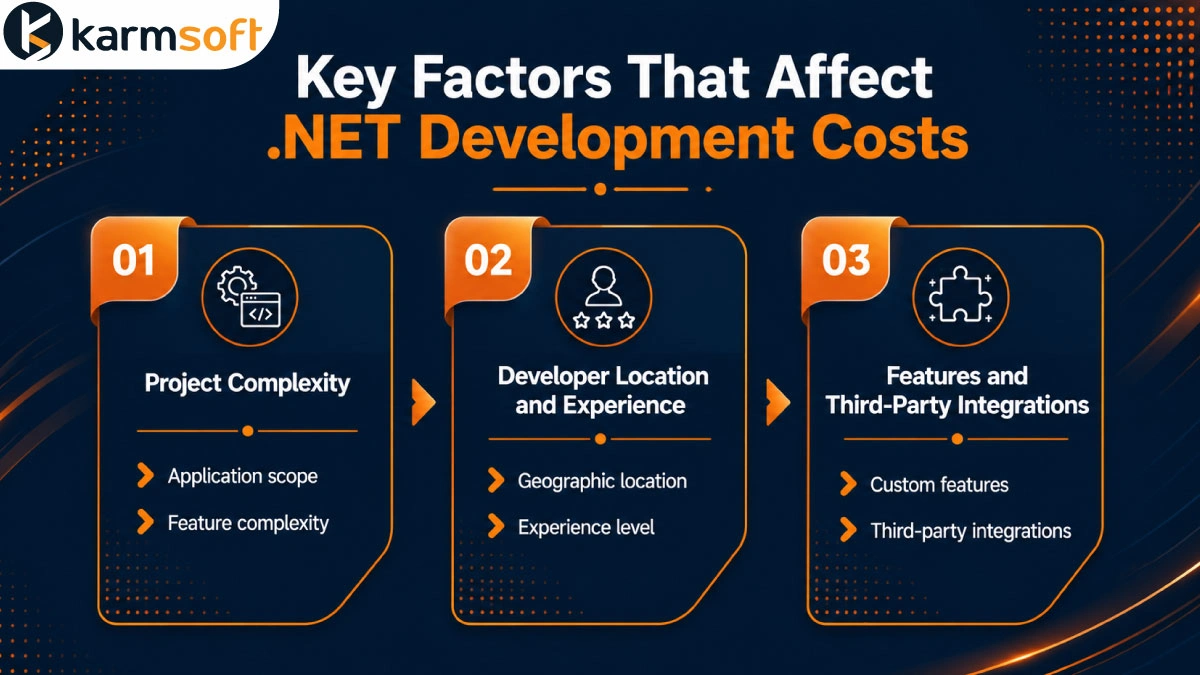
The core element hampering the development cost of .NET applications is project complexity. Larger teams and more development hours are needed for applications with a wider reach, more user roles, advanced processes, and substantial business logic. The entire budget is also increased by feature complexity, such as real-time communication, AI capabilities, reporting dashboards, or cloud-native functionality. The time needed for building software, QA, and release increases with the level of customization and technical complexity.
Project pricing is heavily influenced by the location & expertise of the development team. Professionals in areas like India or Eastern Europe typically charge lower hourly rates than developers in North America and Western Europe. Experience level is a significant factor as well. While junior developers could be less expensive, they need more control; senior .NET developers offer greater technical proficiency, quicker problem-solving, and higher-quality code. Project value can be increased by establishing the correct balance between experience and expense.
.NET development expenses are strongly impacted by the quantity of unique features and external integrations. It takes more work to implement advanced features like payment gateways, authentication systems, AI-powered features, reporting tools, or RBA controls. Implementation and testing times are also extended by integrating third-party services. To effectively minimize development costs, companies could add advanced capabilities in later stages and prioritize key aspects during the initial release.
Also Read: Top .NET Development Companies in Houston (2026 Guide)
Before investing in full-scale development, companies can verify concepts by launching an MVP. Businesses can lower initial development costs, accelerate time to market, and obtain insightful customer feedback by concentrating primarily on critical features. This strategy reduces the possibility of investing resources in unnecessary features. Future stages of development can incorporate new features and improvements based on actual consumer needs after the product has proven effective.
Project expenses and delivery risks can be greatly decreased by choosing a skilled .NET development partner. An effective team creates maintainable code, adheres to proven development procedures, and detects possible problems early in the project. Additionally, they offer precise project estimates, effective resource distribution, and open communication throughout the development process. Selecting a partner with experience in the field helps save expensive rework and enhances software quality. They guarantee timely and cost-effective delivery of your application.
Instead of finishing everything at once, agile development allows companies to develop apps in smaller, more manageable iterations. Frequent releases, ongoing testing, and regular feedback all help in the early detection of problems, which minimizes the need for costly fixes later in the project. Agile also enables teams to swiftly adjust to evolving business needs without interfering with the development process as a whole. This adaptable strategy increases teamwork, boosts product quality, and manages expenses.
Business websites, corporate dashboards, and simple web apps are examples of small .NET projects that usually demand less functionality. The typical development process takes one to three months and costs between $5,000 and $25,000. The complications in interface & testing needs, deployment requirements, all affect the .NET development pricing.
Customer portals, CRM systems, eCommerce platforms, and workflow automation solutions are examples of medium-sized applications. Development typically takes three to six months and costs between $25,000 and $100,000. Advanced functionality, third-party connectors, unique APIs, and improved security are all necessary for these projects.
Enterprise .NET apps require large-scale commercial processes with high security, intricate workflows, cloud architecture, and numerous integrations. Depending on the needs of the company, dot net development costs can vary from $100,000 to $500,000 or more. Typically, the development process takes six to twelve months or more.
The complications, the technology stack, and the project size hamper the total .NET development price. Enterprise-grade platforms frequently cost more than $100,000, whereas basic apps typically cost between $5,000 and $25,000. The mid-size project can price from $25,000 to $100,000. Companies that invest in .NET Core application development services receive cloud-ready solutions that enhance scalability and lower future maintenance costs, making them an affordable long-term technological investment.
The project goals & feature requirements need to determine the different development schedules. Simple applications can be completed in 4–12 weeks, medium-sized projects in 3–6 months, and enterprise software in 6–12 months or beyond. Delivery schedules are influenced by planning, UI/UX design, QA, release & after support. Agile development lowers project risks throughout the lifespan, maintains product quality, and speeds up releases.
The cost of developing .NET is directly impacted by a number of things. The size of the team and the level of developer experience have a big impact on net development cost. Complexity is increased by advanced features like AI, analytics, or real-time processing. Costs are further increased by cloud infrastructure, security needs, third-party API connections, and compliance. To guarantee long-term application stability, the total budget should account for ongoing maintenance, performance optimization, bug recovery, and feature improvements.
Companies can work with a development agency, create an internal team, or hire freelancers. Although they may not be as scalable, freelancers provide reduced upfront fees. Although they offer greater control, in-house teams come with higher hiring and operating costs. When you hire development, you will get experienced developers, organized project management, and quicker delivery. Project complexity, budget, schedule, and long-term corporate goals all impact the best hiring approach.
Also Read: Top .NET Development Company Chicago with Proven Industry Experience
Advanced .NET releases offer significant performance gains, making apps faster and more responsive. Improved runtime optimization limits execution time, whereas better memory management limits resource consumption and boosts stability. These upgrades support businesses in building high-performance web, desktop, and cloud solutions. Improved scalability and optimized processing minimize cost, making .NET a better choice for business.
Security is the core reason organizations invest in .NET development. The framework covers built-in authentication, encryption, and authorization, and secure API support to safeguard business data. It supports firms in matching compliance demands across industries. Frequent security updates strengthen protection against threats to ensure secure, reliable applications.
.NET allows developers to develop apps that run seamlessly on Windows, macOS, and Linux using a single codebase. The cross-platform capability minimizes development effort, lowers maintenance costs, and drives product delivery. Organizations can release apps across various IS without developing separate versions. It offers better flexibility when choosing hosting environments.
.NET is developed for advanced cloud-native app development, making it a better choice for scalable virtual solutions. It integrates seamlessly with Azure. Organizations can build microservices, automate scaling, and streamline app management across the cloud. These capabilities enhance system reliability, limit downtime, and support frequent delivery of rising apps.
Organizations continue to rely on .NET because it is supported by Microsoft. Long-term support releases offer security updates, bug fixes, and stability for enterprise apps. Frequent framework updates verify that the firm can obtain new technologies while managing app performance and security.

Whether you are developing enterprise apps, web services, mobile apps, or cloud solutions, .NET offers the necessary tools and frameworks to make your concept a reality. To get the best development solutions, hire a .NET Core development company today.
Key Takeaways

About the Author
Kaushik Patel, Software Architect at Karmsoft, is a visionary leader in the IT industry. With expertise in web app development, he ensures Karmsoft delivers user-friendly, high-performing solutions. His commitment to excellence drives business growth for clients worldwide.
 .Net Development
 ChatGPT
 Google AI
 Perplexity
 Claude
 Grok
Grok