Blog Flutter App Development
 Cost: Budget Guide for Businesses
October 16, 2026Kaushik Patel
BlogFlutter App Development
October 16, 2026Kaushik Patel

Summarize this blog post with:
Quick Summary
Flutter app development costs depend on factors such as app complexity, features, UI/UX design, integrations, backend requirements, platform scope, and development team expertise. Understanding these factors helps businesses estimate their project budget more accurately.
This guide covers the major development stages, pricing considerations, and additional expenses involved in building a Flutter app. It also provides practical budgeting tips to control costs and avoid unexpected expenses from planning through launch and maintenance.
Table of Contents
Organizations are choosing Flutter for developing apps because it allows teams to develop feature-rich apps for various platforms in a single codebase. The following approach reduces development effort while allowing quick release and consistent user experience across iOS and Android. However, the Flutter app development cost can vary based on factors like app complexity, UI requirements, features, development team location, and ongoing maintenance. Organizations investing in custom Flutter development services should therefore understand what influences the overall budget before a project starts.
The guide explains the major cost factors, development stages, pricing considerations, and additional expenses a firm should plan for when estimating the best custom Flutter app development services cost. According to industry research, the global mobile application market is projected to grow at a 15.5% CAGR from 2026 to 2033, highlighting the growing importance of mobile applications and the need for businesses to carefully plan their development budgets.
The complexity, features, integrations, and development team of the app all have a significant impact on the estimated flutter app development cost. A medium-complexity Flutter app can cost between $25,000 and $60,000, whereas a basic app can cost between $10,000 and $25,000. The cost of complex corporate apps with complex integrations, unique features, and strong security can range from $60,000 to $150,000 or more. These are only approximations that could change depending on the project's needs.
A quick estimate of the expected flutter app development cost in india depending on complexity may be found in the following table:
| App Complexity | Typical Features | Estimated Development Effort | Approximate Cost Range |
|---|---|---|---|
| Simple | Basic UI, login, profiles, limited APIs | 2–4 months | 10,000–25,000 |
| Medium | Payments, notifications, APIs, admin panel | 4–7 months | 25,000–60,000 |
| Complex | Advanced integrations, AI, real-time features, enterprise security | 7–12+ months | 60,000–150,000+ |

User research, wireframing, visual design, interactive prototypes, and responsive layouts are usually included in this. Before development starts, the objective is to design an intuitive interface and determine the general appearance, navigation, and user experience of the application.
Using a single codebase, the application is developed using Flutter for both iOS and Android. To produce an application that is both functional and consistent, developers apply authorized designs, functionality, navigation, integrations, and platform-specific needs.
Databases, server-side logic, authentication, APIs, and third-party integrations are examples of backend development. These elements support the application's essential functions and business processes while ensuring safe data storage, retrieval, processing, and interchange.
Functional, usability, compatibility, performance, and security checks across compatible devices are typically included in testing. Before the application is made available to consumers, developers find and fix issues, check integrations, and make sure it runs consistently.
Preparing application builds, setting up developer accounts, fulfilling Google Play and App Store standards, and submitting the app for review are all examples of deployment services. Businesses can resolve technical problems that may occur during release with the use of launch assistance.
bug patches, performance upgrades, security updates, OS compatibility modifications, feature additions, and technical assistance are examples of ongoing maintenance. Frequent updates contribute to the Flutter application's stability, security, and compatibility with changing platforms and devices.
Also read :- React vs Angular: A Complete Comparison for Your Next Web Project
Depending on its features, a Flutter eCommerce app usually costs between $20,000 and $60,000.Standard development is required for product catalogs and shopping carts; additional complexity is added by payment gateways, order administration, user accounts, and inventory integrations. The entire budget may be further increased by advanced functions like real-time order tracking, various payment choices, and recommendations.
The typical price range for healthcare Flutter apps is between $30,000 and $80,000.Reliable backend systems are necessary for scheduling appointments and managing patients, and robust security and privacy measures are necessary for sensitive health data. Notifications, secure communication, telemedicine, electronic health records, and integration with healthcare platforms can all raise project costs and development effort.
The financial apps need strong security and compliance controls, so a Flutter fintech application might cost anywhere from $40,000 to $120,000+.Development complexity can be increased by fraud prevention, financial connectivity, secure transactions, and authentication. Companies that engage in custom Flutter app development solutions could additionally need transaction monitoring, encryption, specialist APIs, and regulatory features.
The average cost of on-demand Flutter apps is between $25,000 and $70,000.GPS tracking, booking administration, real-time notifications, payment capability, and separate user and provider apps are frequently needed for these platforms. Features like chat, ratings, automated provider matching, live location sharing, and smart scheduling can lengthen development times and raise project costs.
Depending on organizational needs, enterprise Flutter applications typically cost between $60,000 and $150,000+.It takes a lot of work to design complex workflows, business system integrations, role-based access, dashboards, and advanced security. Large businesses may also require analytics, compliance controls, scalable architecture, legacy-system integration, and continuous maintenance, all of which can significantly raise the total cost.
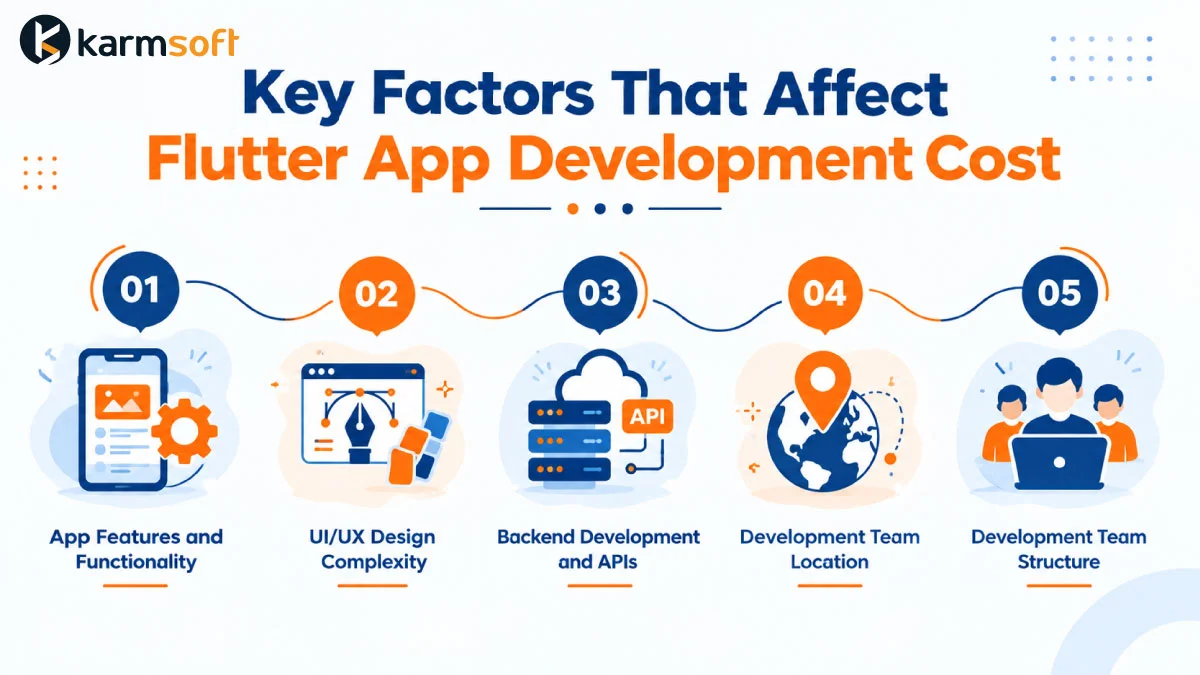
The flutter app development cost 2026 is directly impacted by the quantity and complexity of features. While payment integration, location-based features, and real-time functionality require more development, testing, security, and third-party services, basic authentication and notifications take less work. More advanced functions typically result in longer development times and higher project costs.
A flutter app development cost breakdown can be greatly impacted by UI/UX design. In general, a standard interface with straightforward navigation is less expensive. More design and development work is needed for custom animations, branded interfaces, micro-interactions, and advanced interactive designs, which raises the overall cost while producing a more unique user experience.
The overall cost of development is also greatly influenced by backend requirements. Additional development and testing are essential for applications that require complicated databases, numerous third-party connectors, APIs, user administration, or cloud infrastructure. While scalable architecture and advanced integrations might significantly raise the project budget, a straightforward backend may reduce costs.
Due to regional variations in hourly rates, developer location can result in significant variations in Flutter development costs. While Asian and offshore teams frequently provide more affordable options, US-based developers usually charge the highest fees, followed by many European teams. Companies looking for custom flutter app development apps should evaluate pricing, quality, communication, and expertise.
The overall budget is also impacted by the development model selected. Although they may have fewer resources for larger projects, freelancers can offer reduced upfront fees. Although they come with wages and operating costs, in-house developers provide more control. Dedicated designers, developers, testers, and project managers can all be found in one team at a Flutter app development business.
First, create a minimum viable product with the necessary functionality. This minimizes early development expenses, permits quicker market testing, and gives vital user feedback before investing in additional capabilities.
Determine which features directly support user demands and corporate objectives. Prioritizing the development of high-priority items helps avoid wasting money on things that might not be very useful at launch.
Reusable components and widgets can improve application consistency and minimize repetitive development work. This method allows future feature additions and design upgrades while saving development time.
Before development starts, clearly outline features, workflows, integrations, and design requirements. Early planning helps developers estimate the project more precisely and reduces scope modifications, rework, delays, and unforeseen costs.
Consider technical proficiency, portfolio, communication, cost, and post-launch assistance when choosing a development partner. The correct team can effectively supply reliable options while assisting in the avoidance of expensive development errors.
Instead of building everything at once, divide the project into manageable development phases. This helps companies to manage expenditures, assess development, gather input, and progressively roll out cutting-edge features according to priorities.
Also Read: Top 15 Software Development Outsourcing Companies in India (Edition 2026)
A skilled Flutter development team at Karmsoft is dedicated to creating reliable, effective mobile apps. Its developers are capable of managing a wide range of project needs while adhering to modern development techniques and preserving code quality.
Karmsoft offers unique mobile application development that is suited to certain target groups, corporate goals, and workflows. Instead of depending on generic solutions, this method assists companies in developing apps with essential features.
Karmsoft uses a scalable development methodology to accommodate evolving demands and corporate expansion. Over time, applications can be designed to support growing numbers of users, features, integrations, and changing operational requirements.
Karmsoft creates unified apps by integrating backend knowledge with UI/UX design. For a comprehensive mobile experience, our methodology integrates user-friendly interfaces with dependable backend systems, databases, APIs, and integrations.
To maintain application performance after launch, Karmsoft offers testing and continuous support. Updates, improvements, bug fixes, and ongoing maintenance can help keep Flutter apps dependable and in line with changing needs.
Add 2nd CTA Image ( Ready to Make Your Flutter App Investment Count?)

First, evaluate the app’s features, integrations, complexity, and development requirements to estimate the final cost. Plan your features carefully and prioritize elements that support your business goals. Collaborating with a custom Flutter app development company helps you select suitable technologies and resources. Finally, select the development model that aligns with your budget, timelines, and scalability requirements for better cost control.
Key Takeaways

About the Author
Kaushik Patel, Software Architect at Karmsoft, is a visionary leader in the IT industry. With expertise in web app development, he ensures Karmsoft delivers user-friendly, high-performing solutions. His commitment to excellence drives business growth for clients worldwide.
 ChatGPT
 Google AI
 Perplexity
 Claude
 Grok

