Blog React Native
React vs Angular: A Complete Comparison for Your Next Web Project
October 05, 2026Hardik Panchal
BlogReact Native
October 05, 2026Hardik Panchal

Summarize this blog post with:
Quick Summary
React offers flexibility, reusable components, and a vast ecosystem, making it a popular choice for building modern and dynamic web applications. Its adaptable approach gives developers greater control over project architecture, tools, and development workflows.
Angular provides a structured, full-featured framework with built-in tools for developing scalable applications. Compare React and Angular across performance, SEO, scalability, flexibility, learning curve, tooling, and use cases to choose the right technology for your project.
Table of Contents
The selection of the Frontend Technology impacts the speed, cost, scalability and maintenance of a web project. According to the Stack Overflow Developer Survey 2024, React.js was used by 39.5% of professional developers, while Angular was used by 19.8%, highlighting the different levels of adoption between the two technologies. React and Angular both exist, but there are different ways of working with them. The key features, benefits and applications of this react vs angular comparison are discussed here.
React is a JavaScript library developed by Meta, whereas Angular is a complete front-end framework by Google. A dependable React JS development company India can assist with creating flexible React applications, and Angular is ideal for structured projects.
Here's a guide to the differences between react and angular, the performance, development, scalability, cost, and the angular vs react JS difference.
React is a JavaScript library, developed and maintained by Meta. A component-based approach to interactive user interfaces creation. Developers can utilize the reusable components to compose a website with a single page, dashboard, web-based e-commerce platform, and more.
A react JS development company can also integrate various libraries and tools as per the project needs and specifications. This flexibility is ideal for teams that prefer to have control over their technology stack.
The features of React include a Virtual DOM, reusable components, one-way data binding, and JSX. There's also its sizable ecosystem and flexibility with third party libraries. These characteristics make react development solutions appropriate for projects that require a bespoke front end architecture.

Angular is a framework created and maintained by Google for the front end. It is developed mostly using TypeScript and offers many features essential for creating a big application.
Angular provides a more structured development environment as compared to React. This is why it is popular among enterprise applications to ensure uniformity of architecture and development processes.
Angular comes with two-way data binding, dependency injection, built-in routing, form handling, Angular CLI, component-based architecture, and development and testing tools. It integrates, which can save on a number of external packages.
Also read :- React Native Best Practices for Scalable and Maintainable Apps
React is more flexible because developers can use supporting libraries as per the project requirements. It is this flexibility that is often made use of by react development services to make custom applications.
Angular offers a more organized structure and a ton of ready-to-use features. React's flexible approach is ideal for loosely coupled projects, where Angular's standardisation is better.
React uses a Virtual DOM to efficiently update user interface elements. Angular employs change detection to detect and update changes. The angular vs react performance debate is thus determined by the application design, rendering requirements, code quality and optimisation.
If the developers implement appropriate optimisation techniques both technologies can achieve good performance.
In general, React can be easier for JavaScript programmers to start with. Angular has several additional concepts: TypeScript, dependency injection, RxJS, and Angular-specific patterns.
React is suitable for web apps that can be flexible.React is good for flexible web applications and interactive interfaces. In cases of more complex applications with a standard structure, Angular might be a good choice. Both options have their merits depending on the business objectives, team capabilities and technical needs.
Add inner image ( React vs Angular: Detailed Comparison )
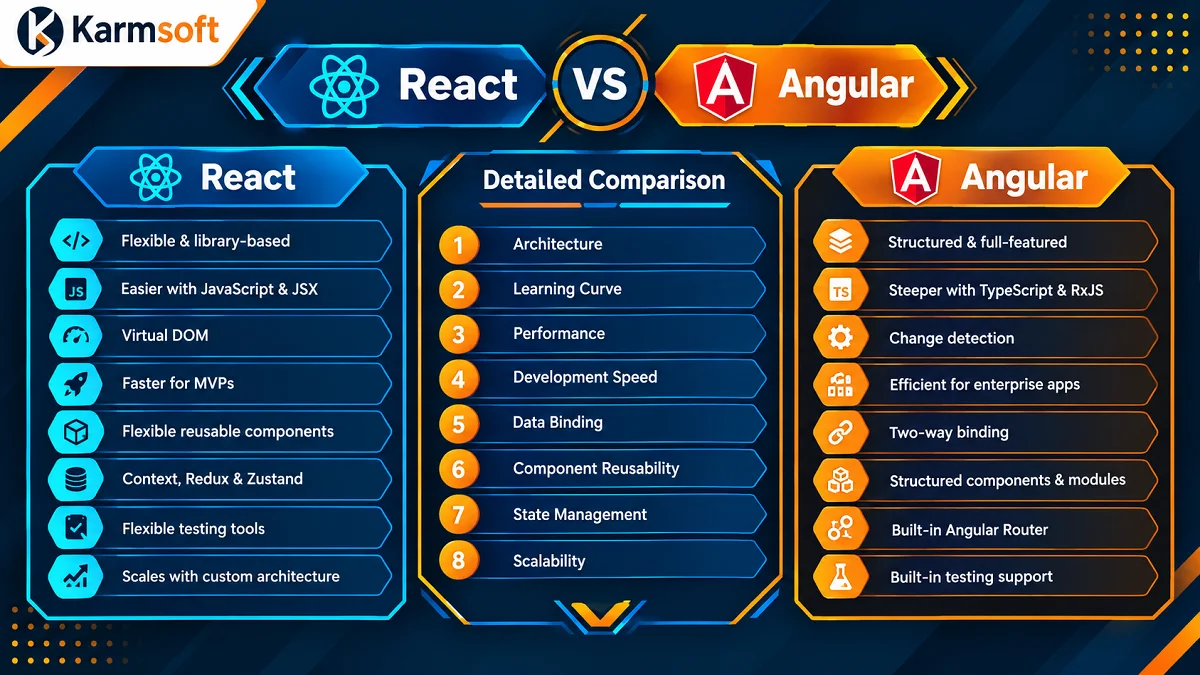
React takes a flexible methodology by using the libraries, and developers can select extra tools depending on the project's requirements. Angular offers a full-fledged architecture and tons of inbuilt features. One of the significant differences between react vs angular is this.
For teams that would like a specific technology choice, they might prefer using React. However, teams that are building large and complex applications might find it useful to stick to the standard structure and development method of Angular.
The only required knowledge is of JavaScript and JSX. As the application develops, new libraries and tools can be incorporated as needed. You'll need TypeScript knowledge, as well as concepts like dependency injection, RxJS, services, and Angular architecture.
React may seem more straightforward to get started with for beginners. Angular is definitely going to need more time to learn, but may allow for more uniformity of development for more experienced teams.
React's Virtual DOM allows for more efficient updates to UI, and Angular has change detection which detects and updates changes. Both angular and react may not be the best choice for every project.
Real world performance is heavily influenced by the size of the application, rendering patterns, network requests, code structure and optimisation. Both technologies can be enhanced by developers. By minimizing unnecessary rendering, optimizing assets and coding them efficiently, developers can enhance their apps.
React offers shareable components, and a wide variety of libraries. Tools for developers may be chosen depending on the project needs. Many of the tools used in Angular are built-in, which can help speed up its structured development and help to avoid having to use additional packages.
React can give you more flexibility during the development process for an MVP or startup project. In larger enterprise applications, the built-in tools and typical structure of Angular can assist with quicker, more reliable development.
One-way data binding is the primary binding that React works with. This simplifies data flow and its handling and debugging, particularly in applications with many interfaces. Angular has two-way data binding that can make some form and UI interactions easier. When deciding which data-handling method to use for an app, the angular vs react JS distinction takes center stage.
Both technologies offer reusable components, this can save development effort and ensure consistency. Components can be used throughout an application, ensuring there is uniformity in the user interface for all parts.
Angular also structures the functionalities of the application in terms of components and modules. Teams can develop UI definitions and services that can be used across large applications.
Context, Redux, Zustand, and other state management solutions can be used in react projects. This allows developers to have a number of choices when dealing with app data and shared states.
Angular utilizes services, signals, and other state management libraries for state management. It is dependent on the complexity of the application, the quantity of data being shared and the preferences of the application development team.
React Router is a commonly used routing solution by React. React being a library, the developer can choose the routing approach that is best suited to his application.
Angular Router is included in the Angular framework. It provides means to manage routes, navigation, guards etc and other application needs. React has more options, and Angular has more of an integrated routing experience.
React has various unit, component, integration and end-to-end testing tools and libraries available. A react JS development company has the flexibility of choosing the testing tools based on the technology stack and needs of the application.
Angular also has a robust testing ecosystem, as well as a support for structured testing practices. They are both capable of providing reliable software, if developers do testing during development.
With a well-defined architecture, component organization, and state management strategy, react apps can scale effectively. As the application grows in size, however, teams will have to make more architectural decisions.
Angular offers an opinionated structure which might assist large groups of people to be consistent. It comes with a number of built-in features that can be used to support complex applications comprising multiple modules and development teams.
React has a huge community, and thousands of third-party packages for various development requirements. It offers developers flexibility with the tools they use to build UI, manage state, route, test, and more.
There is also a good community and extensive official tooling around Angular. Both technologies provide documentation, learning resources, libraries and experienced developers. When companies require expert knowledge and scalable development assistance in React, they can collaborate with a react software development company India.
React works seamlessly with the React Native environment, enabling developers to create cross-platform mobile apps based on the principles of React. This may be helpful for companies that have Web and mobile products.
Ionic and its related technologies can be used with Angular for cross-platform mobile application development. The development method is not the same as React Native, though. When choosing a technology for a team that is building both a web and a mobile application, the key factors to consider are existing skills, the project requirements, performance expectations and long-term maintenance.
React has flexible architecture, reusable components, a robust ecosystem, efficient UI rendering, and is more easily adopted for many JavaScript developers. A React JS development company India can also tailor the technology stack according to the needs of the business.
Routing, forms and other functionality might need additional libraries in React. There may be variations in project structures between teams. Regular technology evaluation could be needed due to frequent ecosystem changes.
Angular has cross-platform support, an excellent type support, built-in routing, built-in forms, project structure and features for big enterprise apps.
Angular has a learning curve that is steeper and has more concepts. It has a full array of features that may be more than a small project can require.
React can be used in start-ups, MVPs, SaaS apps, e-commerce websites, interactive interfaces, and projects that need a flexible frontend. If JavaScript is a strong writing language for your team, you might also find it easier to adopt React.
This is because Angular can be used for enterprise applications, complicated dashboards, internal platforms, big development teams, and projects that rely heavily on using TypeScript and standardised architecture.
When choosing a framework, these react vs angular differences should be considered.
Also read :- Top React Native Development Services to Build High-Performance Apps
React can be a good fit if business enterprises require flexibility in their tech stack, phased rollouts, a large talent pool, and tailored architecture. A react software development company in India can help develop and expand such solutions.
Angular is a good option if an organisation requires consistent code across large teams, enterprise functionalities, consistency in coding style, and support for TypeScript.
Cost is dependent on the complexity of the development, the availability of the developer, initial development needs, maintenance, third party dependency and scalability.
Angular can decrease the need for a variety of external tools, and React can decrease the initial complexity for some projects. Hence, when deciding between angular and react performance and cost, focus should be given to the application's entire life cycle, not just on development speed.
Examine complexity of applications, performance requirements, features needed, and scalability. When comparing two technologies, such as Practical react vs angular, it's crucial to start with project requirements.
Assess JavaScript and TypeScript skills, team size, and experience. With a react software development company India, you can utilize their expertise and development assistance for working with React.
The flexible ecosystem of React can enable fast development for an MVP. Angular can be a good way to go for larger projects that have more specific needs.
Make sure to take into account changes, code uniformity, developer introduction, 3rd party dependencies and future functionality before deciding.
It's not a win-win situation when comparing react to angular. When flexibility, reusable components and a custom technology stack is important, React is a good option. Structural consistency, built-in features, TypeScript, and enterprise-scale consistency are priorities for whom for which Angular can be better.
The conclusion of angular vs react JS is finally up to the project objectives, experience of the team, finances, and plans for the future. Knowing the distinctions between react vs angular can assist companies make an educated decision on technology.
For specialised react development services, businesses can compare providers carefully and choose the best react JS development company in India based on technical expertise, portfolio, communication, scalability, and project requirements.

The technology that is used in the front end of an application depends on several factors: project objectives, complexity, performance, budget, and growth. React can be used for flexible projects and Angular can be used for structured and enterprise projects.
A best react JS development company in India can suggest the appropriate react architecture, and a good react JS development company can offer customized solutions. Another factor to consider when choosing between business react development services is their technical abilities, scalability, and maintenance.
Key Takeaways

About the Author
Hardik Panchal, CTO, Scrum Master, and Software Architect at Karmsoft, leads the charge in creating innovative web and mobile applications. His technical expertise and commitment to client satisfaction drive Karmsoft’s success. Hardik is passionate about turning ideas into practical digital solutions that help businesses grow.
 ChatGPT
 Google AI
 Perplexity
 Claude
 Grok
Grok