Blog Umbraco Development
Comprehensive List of Umbraco Integration Services for Digital Transformation
June 15, 2026Kaushik Patel
BlogUmbraco Development
June 15, 2026Kaushik Patel

Summarize this blog post with:
Digital transformation is not only altering the way businesses handle content but also how they manage customer experiences and operations. To keep pace with the rising requirements, businesses are stepping up their investments in the next-gen Umbraco development services and digitally integrated solutions. According to IDC, worldwide spending on digital transformation is forecast to reach almost $4 trillion by 2027, highlighting the rising demand for modern digital platforms and integrated business solutions.
Umbraco constitutes an adaptable open-source CMS that equips businesses for building scalable websites and enterprise-grade platforms. Several businesses prefer partnering with an experienced Umbraco development company for the creation of tailor-made digital experiences and operational efficiency gains.
Moreover, businesses count on Umbraco integration services for linking CRM systems, ERP platforms, analytics tools, and cloud applications, which result in better workflows, centralized data, and superior digital experiences.
Umbraco integration services refer to the process of integrating the Umbraco CMS platform with external business systems, third-party applications, APIs, and enterprise tools.
Such integrations are a key to simplifying organizations' operations, automating workflows, and providing better access to data across different departments.
Usually, businesses are in search of an experienced Umbraco integration company or Umbraco integration agency that can tailor the integrations exactly to the needs of their business operations.
Integration is a major driver of process improvements. One of the ways it does so is by enabling real-time data sharing, workflow automation, and seamless communication between systems. For instance, linking Umbraco to a CRM platform gives companies a better handle on customer data, whereas ERP integration boosts the management of resources and overall visibility into the operations.
New development initiatives around the Umbraco website are increasingly dependent on integrations for establishing a connected digital ecosystem that benefits the users' experience as well as the internal business operations.

The main objective of digital transformation is to connect systems, people, and customer experiences, making use of smart technology solutions. Integrations are indeed a core element that businesses rely on for achieving this.
One of the most significant upsides of Umbraco integrations is data centralization. Thereby, companies are capable of handling customer data, operational data, marketing insights, and analytics through a unified platform, which enhances transparency and decision-making.
Through the automation of repetitive tasks and the reduction of manual data entry, integration significantly helps in enhancing operational efficiency. Besides, the synchronization of data across diverse systems enables a seamless flow. Companies leveraging the advanced capabilities of Umbraco web development services stand to gain a lot in terms of streamlining workflows and improving productivity.
An enhanced client experience is one of the main points. With connected systems at their disposal, organizations are able to provide personalized content, support that is speedy, and digital interactions that are consistent across the board, including web portals, mobile apps, and customer interfaces.
Umbraco integrations enable businesses to keep all their customer information, operational data, analytics, and content management together in a single cohesive digital system. Having centralized data facilitates efficient inter-departmental collaboration and gives businesses quick access to up-to-date information.
When looking to customize their Umbraco development, many organizations give top priority to centralized data management as a way of minimizing information silos, enhancing visibility into workflows, and ultimately, creating better operational efficiency.
Through the integration of various digital systems, companies can craft customer experiences that are not only personalized but also easily accessible and consistent through different touchpoints like websites, mobile devices, and customer portals.
Customers are given targeted content, support response times are shortened, and communication is made uniform, thanks to the interconnection of CRM and marketing systems.
Improving customer engagement is at the heart of a lot of modern Umbraco website development work carried out by partnering with an integration expert.
With the help of Umbraco integration services, a business can count on automating the workflows, keeping the business data in sync, and minimizing the manual repetitive tasks performed by different departments.
Automation is a productivity booster, by removing human errors it reduces the cost of mistakes, and by accelerating operational processes it gives an ultimate edge over the competitors.
Businesses can anticipate workflow management enhancements, organization-wide operational efficiency, and eventually business growth fueled by the integration of various enterprise systems if they have partnered with superior Umbraco development consulting services.
Umbraco has inherent integration capabilities that not just cater to current operational needs but also offer the potential to scale up and adapt to changed needs in the future. Through integration, businesses are able to connect to various cloud platforms, e-commerce systems, APIs, and enterprise applications without having to undergo major infrastructure changes.
Evolutionary digital growth, operational flexibility, and long-term scalability are some of the reasons why organizations resort to Umbraco solution development.
Integration of systems gives the business a bird's eye view of the entire organization through centralized analytics and real-time business insights, which in turn support better decision-making with a strategic focus.
Keeping tabs on customer behavior, sales, marketing effectiveness, and various other operational trends becomes easier and more precise with integrated systems.
Teams that have hired an experienced Umbraco integration company are the ones that enjoy better insight into enterprise data, which aids their leadership in making swifter and more informed business decisions.
Well-executed integrations serve as a catalyst to ramp up business productivity and optimize technological investments by not only trimming down operational costs but also by enhancing performance while creating customer experiences.
Investment in Umbraco development services leads, in many cases, to automation, operational optimization, and digital capabilities improvements, which translate into the strongest performance and subsequently a high ROI in the long term.
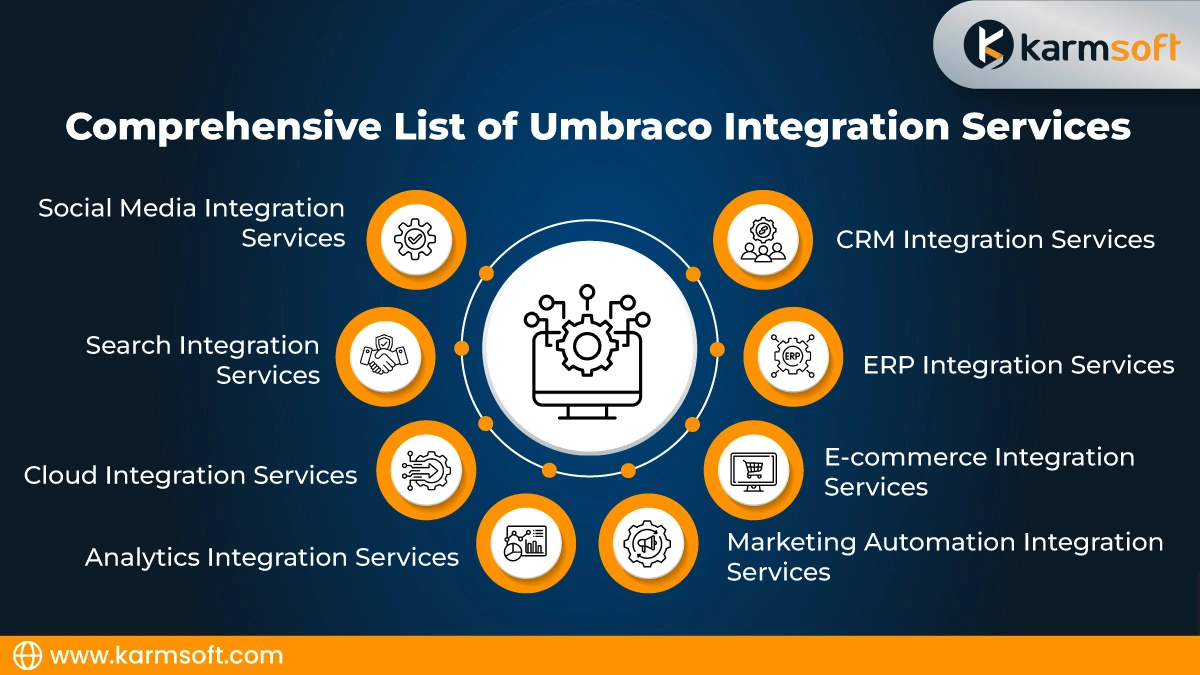
CRM integrations make it possible for organizations to improve the management of customer interaction operations and streamline sales activities.
With Umbraco integrated with CRM platforms like Salesforce, HubSpot, Microsoft Dynamics, or Zoho CRM, companies are able to consolidate customer data, which leads to improved collaboration between marketing, sales, and support teams.
With the help of these integrations, organizations are able to keep customer records up-to-date, automate lead management processes, and employ various customer engagement tactics. Moreover, through CRM integration, monitoring of customer interactions, personal communication, and the attainment of higher conversion rates are made possible via data-driven marketing and sales processes.
These integrations support:
It is not uncommon for organizations to join hands with a skilled Umbraco integration agency to improve operational efficiency and customer relationship management through CRM integrations.
ERP integrations link Umbraco to enterprise resource planning systems, thereby making it possible for a company to automate business processes and enhance the efficiency of the management of its operations.
The businesses that have their ERP platforms connected with Umbraco are in a better position to update their operational data in all departments, such as finance, inventory, procurement, logistics, and HR, without any hassles.
Besides facilitating the automation of workflows, ERP integrations contribute to the reduction of errors caused by manual data entry and offer a real-time perspective of business operations.
With connected enterprise systems, businesses can also enhance their inventory tracking, order processing, and financial reporting.
ERP integrations support:
Those enterprises that have gone for Umbraco custom enterprise solutions factor in ERP integration as their top priority to facilitate visibility into the conduct of the entire organization and business scalability.
E-commerce integrations bring Umbraco and the business's online storefronts, payment gateways, inventory, and customer management systems together.
This way, the company is capable of creating a friction-free e-commerce experience from the customer's perspective and also meeting the back-end requirements for efficient management.
By interlinking e-commerce elements, such systems allow businesses to take care of their products, keep their inventory updated, securely handle payments, and streamline order fulfillment.
On top of this, companies can advance their ability to satisfy customers through real-time product availability, smartly tailored shopping, and quicker processing of orders.
Key benefits include:
Today, Umbraco development projects very often include the use of e-commerce integrations to support scalable business operations and performance.
Marketing automation integrations help businesses automate campaigns, customer communication, and lead management activities. Integrating Umbraco with marketing platforms such as HubSpot, Mailchimp, Marketo, or ActiveCampaign improves customer engagement and digital marketing performance.
Through these integrations, companies can better track consumer behavior, segment audiences, automate email campaigns, and nurture leads. Marketing automation also helps organizations improve campaign targeting, customer retention, and conversion optimization.
These integrations support:
Businesses using Umbraco development consulting services often integrate marketing automation tools to improve marketing efficiency and customer engagement strategies.
Analytics integrations provide organizations with the means of effectively monitoring website performance, customer behavior, and digital business metrics. By linking analytics platforms like Google Analytics, Power BI, or Adobe Analytics with Umbraco, the businesses get access to real-time operational insights as well as performance data.
By tracking traffic sources, monitoring user engagement, analyzing conversion rates, and assessing content performance, companies are able to make more informed decisions. Analytics platforms also provide support to organizations that want to improve customer experiences and digital marketing effectiveness through the use of data-driven strategies.
Key capabilities include:
Business intelligence and operational visibility are improved by the implementation of advanced analytics and reporting systems by a well-informed Umbraco integration expert.
Also read :- Top 10 Umbraco CMS Features Decision Makers Must Leverage in 2026
With cloud integrations, businesses can extend their reach by linking Umbraco to various cloud platforms and infrastructures that are remote, which translates to digital operations that are safe, scalable, and flexible.
Working together with distributed teams and operating in different business environments, cloud integration is a great enabler that businesses can benefit from. The integration of Umbraco with leading cloud services such as Microsoft Azure, AWS, or Google Cloud not only enables remote working scenarios but also supports scalable hosting and secure data storage.
The use of cloud-based environments further enhances capabilities in disaster recovery, system reliability, and operational scalability.
Among the benefits are:
Cloud integration is becoming increasingly important for organizations adopting modern Umbraco solution development strategies and scalable digital transformation initiatives.
Search integrations enhance the website search capability, navigation, and content discovery experience for users. A highly efficient search system plays a great role in helping users find relevant content, products, and information.
For this reason, companies integrate Umbraco with search platforms like Elasticsearch, Azure Cognitive Search, or Solr to upgrade search precision and individualized content supply.
Such integrations support:
Custom Umbraco development is one of the main reasons why businesses consider adding search functionality so as to enhance user experience and content discoverability.
Social media integration means connecting the main digital platforms of a business with the corresponding social media channels to maximize audience engagement, content distribution, and brand visibility. Content sharing, social engagement tracking, and interactive audience communication are some of the benefits that these integrations offer to organizations.
Companies can integrate Umbraco with websites such as Facebook, LinkedIn, Instagram, X, and YouTube to complement digital marketing activities and maximize customer interaction. Besides, social integrations give a good opportunity for companies to study audience behavior and improve campaign effectiveness.
They can be used for:
Development of a social media integration feature has been incorporated into a lot of Umbraco website development projects for the purpose of increasing customer engagement, online exposure, and digital marketing performance.
Also read :- Umbraco Consulting Company in Canada for Custom CMS Development
Implementing Umbraco integrations is seen by many companies as a very technical endeavor that can give rise to quite a few challenges. Integration of different business systems, cloud platforms, APIs, and enterprise applications is a task that entails thorough planning, technical knowledge, and well-thought-out development strategies.
Lack of good implementation will make integration issues adversely affect system performance, security, data accuracy, and general business operations. Organizations collaborating with skilled Umbraco experts are not only minimizing risks but also resulting in more stable, scalable, and efficient integration environments.
The bulk of organizations that still rely heavily on their legacy systems are those that were based on older technology and architectures. Therefore, it is very unlikely that these systems will support modern APIs, cloud environments, or advanced integration frameworks, thus making the integration with Umbraco a challenging task.
Besides, legacy enterprise applications may mostly consist of custom-built structures, unsupported software versions, or even limited documentation, thereby leading to compatibility problems during integration projects. Companies creating Umbraco custom enterprise solutions will, in most cases, need middleware platforms, custom APIs, or extra integration layers as a means of linking legacy infrastructure with digital systems of modern times.
Doing a thorough system analysis along with a technical assessment is a prerequisite for, among other things, identifying compatibility gaps and planning effective migration or integration strategies.
When tackling Umbraco integration projects, migrating data is always a major problem. It is a common scenario for the business to have to move a large amount of customer records, product data, content assets, and operational history from their legacy systems to the new integrated Umbraco setups.
Without deciding on a migration plan in advance, you may find that data gets duplicated, some records are missing, there could be formatting inconsistencies, disruptions in operations, and so on. In some instances, the business may also be serving incomplete or unstructured data coming from legacy systems, which is another problem on its own.
Data ought to be validated, cleaned, and sorted before a migration is even contemplated. The use of proper testing and backup strategies further contributes to minimizing risks and ensuring system efficiency during digital transformation initiatives.
Get the basics right. APIs are the backbone of connecting Umbraco to CRM systems, ERP platforms, cloud applications, analytics tools, and third-party services. The catch, however, is API integration that can become problematic with cases like authentication failures, rate limits, version mismatches, connectivity problems, or a lack of proper API documentation.
Limited API capabilities may also be a factor for some third-party applications that restrict data synchronization or workflow automation. Such technical constraints can cause the development process to be slowed and result in communication problems between connected systems.
Partnering with an experienced Umbraco integration company allows businesses to handle API complexities not only to raise integration reliability but also to be secure in communications between enterprise systems and external platforms.
When it comes to Umbraco integrations, especially those that involve customer data, financial systems, payment gateways, or enterprise applications, security becomes a huge concern.
By faulty or improper security practices, the organization is exposing itself to risks of data breach, cyberattacks, unauthorized access, and a violation of compliance that might even lead to penalties. When it comes to Umbraco development services, businesses should foster the implementation of strong security measures like encrypted APIs, secure authentication methods, role-based access controls, and continuous monitoring systems.
Besides, conforming to regulations like GDPR and data protection standards is very instrumental in building customer trust and avoiding any form of legal exposure. It is also highly recommended to conduct regular security testing and vulnerability assessments to identify and fix any potential threats before they disrupt the business functions.
Integrations gone wrong lead to a slowdown of your website, cause application downtime, and ultimately result in a very poor user experience. Examples of such issues include large bulk data movements, slow APIs, inefficient database queries, and badly configured workflows.
The performance issues become obvious as the company expands and the amount of data processed rises. Slow integration will affect not only customers' experience but also internal productivity and overall efficiency in operation.
Companies should make it a point of duty to keep monitoring integration performances, streamline workflows, up their database management game, and carry out regular load testing in order to have a scalable and reliable digital operation. A well-optimized performance results in quick system response times, and it is a key support for long-term business growth.
There are quite a number of things to be done to ensure a successful Umbraco integration besides merely avoiding common mistakes. You need a good plan in place, implementation of strong security measures, performance optimization, and regular maintenance. A company should adopt a systematic integration method to guarantee long-term scalability, reliability, and operational efficiency.
A successful integration project indeed starts with proper planning and thorough business analysis. It is also very fundamental that an organization clearly defines its business objectives, determines its integration needs, and figures out how various systems are going to work in harmony before deciding on any implementation.
Having a solid integration plan in place will go beyond helping your business dodge technical issues; it will also lessen implementation delays and give rise to improved workflow efficiency. A great deal of companies working with an experienced Umbraco development company are able to draft integration strategies that are conducive to their long-term digital transformation goals.
Security must not only be top of your mind whenever you are undertaking Umbraco integration projects, but it should equally be given its rightful place throughout the project implementation cycle. To secure sensitive business and customer information, businesses are expected to implement data encryption, secure APIs, authentication controls, and compliance policies, among others.
Adhering to a set of governance and security frameworks will further lower operational risks, help to prevent unauthorized access, and maintain regulatory compliance across connected systems and applications.
Monitoring API performance, optimizing database queries, and conducting systematic load testing are just some of the ways through which businesses can sustainably ensure system stability and scalability. The impact of poor integration optimization goes as far as affecting the website speed, application performance, and user experience.
Many organizations leveraging advanced Umbraco web development services center to a large extent on performance optimization with good operational efficiency, faster system response times, and superior digital experience quality being some of the resulting benefits.
Integrations that do not fail in the long run are those that get consistent checking, periodical upgrades, and have proactive maintenance in their records, to name a few attributes.
Businesses should be in the habit of continuously monitoring their integration performance, addressing compatibility issues without delay, and updating their systems in order to be able to support evolving business demands and future digital expansion.

Present-day firms are in dire need of interconnected digital ecosystems as a means to not only drive efficiency but also enhance customer experience and operational scalability. Umbraco integration services for various organizations make it possible to hook up different systems, such as CRM, ERP, cloud services, analytics tools, and enterprise applications, into one single digital environment.
Choosing to work with a highly skilled Umbraco development company, a trustworthy Umbraco integration agency, or a capable Umbraco integration guru is a sure way of realizing a business that is secure, scalable, and ready for the future when it comes to the creation of integration solutions.
Through advanced Umbraco development, the use of intelligent integration, and custom Umbraco development, companies can rapidly digitally transform, enhance their operational efficiency, and build better customer experiences in a digital world that is becoming increasingly competitive.

About the Author
Kaushik Patel, Software Architect at Karmsoft, is a visionary leader in the IT industry. With expertise in web app development, he ensures Karmsoft delivers user-friendly, high-performing solutions. His commitment to excellence drives business growth for clients worldwide.
 ChatGPT
 Google AI
 Perplexity
 Claude
 Grok
Grok